Category Archives: Waterjet & Laser

Laser Cutting for Accurate Adelaide Fabrication

Laser Cutting for Accurate Adelaide Fabrication

A drawing that looks straightforward on screen can become an expensive delay on the workshop floor if holes are undersized, edges need reworking or parts arrive late. Laser cutting gives Adelaide fabricators, builders and designers a fast way to turn accurate digital files into production-ready components, particularly where clean profiles, repeatability and efficient turnaround matter.

For brackets, panels, machine parts, architectural features and custom metalwork, the right cutting process reduces fitting time before welding, folding or installation begins. The key is not simply choosing a laser because it is fast. It is matching the process to the material, thickness, finish requirement and the job that follows.

Where laser cutting performs best

Laser cutting uses a focused beam to melt or vaporise material along a programmed path. An assist gas clears the cut, leaving a precise profile with a narrow kerf. Because the cut is controlled directly from a CAD file, it is particularly effective for repeat parts, detailed internal features and profiles that would take far longer to mark out and cut manually.

For many fabrication jobs, speed is the first advantage. A CNC laser can process sheet-metal components efficiently, especially in thin to medium-gauge steel, stainless steel and aluminium. This makes it a practical option for one-off prototypes as well as larger production batches, provided the file and material specification are clear from the outset.

Accuracy is equally valuable. When a set of tabs, slots, bolt holes and outside profiles is cut consistently, assembly becomes more predictable. Fabricators spend less time opening holes, grinding edges into shape or correcting pieces that do not line up. That can protect margins on a job where labour, rather than raw material, is the real cost pressure.

Laser cutting also offers considerable design freedom. Decorative screens, signage elements, balustrade infills, equipment guards and detailed feature panels can include fine linework and repeated patterns that would be difficult to achieve by conventional cutting. A good result still depends on sensible design decisions. Very narrow bridges, extremely small holes and tightly packed details need to suit the material thickness and the final application.

Laser cutting is fast, but heat matters

A laser is a thermal cutting process. That is its strength for efficient metal cutting, but it is also the reason process selection deserves proper attention. Heat is concentrated in a small area, yet it can create a heat-affected zone at the edge of the part. On many steel, stainless steel and aluminium jobs, this is entirely acceptable and the parts can move straight into fabrication.

Where edge condition is highly critical, however, the material and downstream process need to be considered. A component that will be welded, polished, coated, machined or used in a high-tolerance assembly may have different requirements from a standard bracket or enclosure panel. Some parts will need a light clean-up; others will benefit from an alternative cutting method.

Thickness also changes the equation. Laser cutting remains highly capable across a useful range of metal thicknesses, but cutting speed, edge finish and cost vary as material gets heavier. The best choice is rarely based on thickness alone. Grade, sheet condition, required tolerance, part geometry and quantity all influence the outcome.

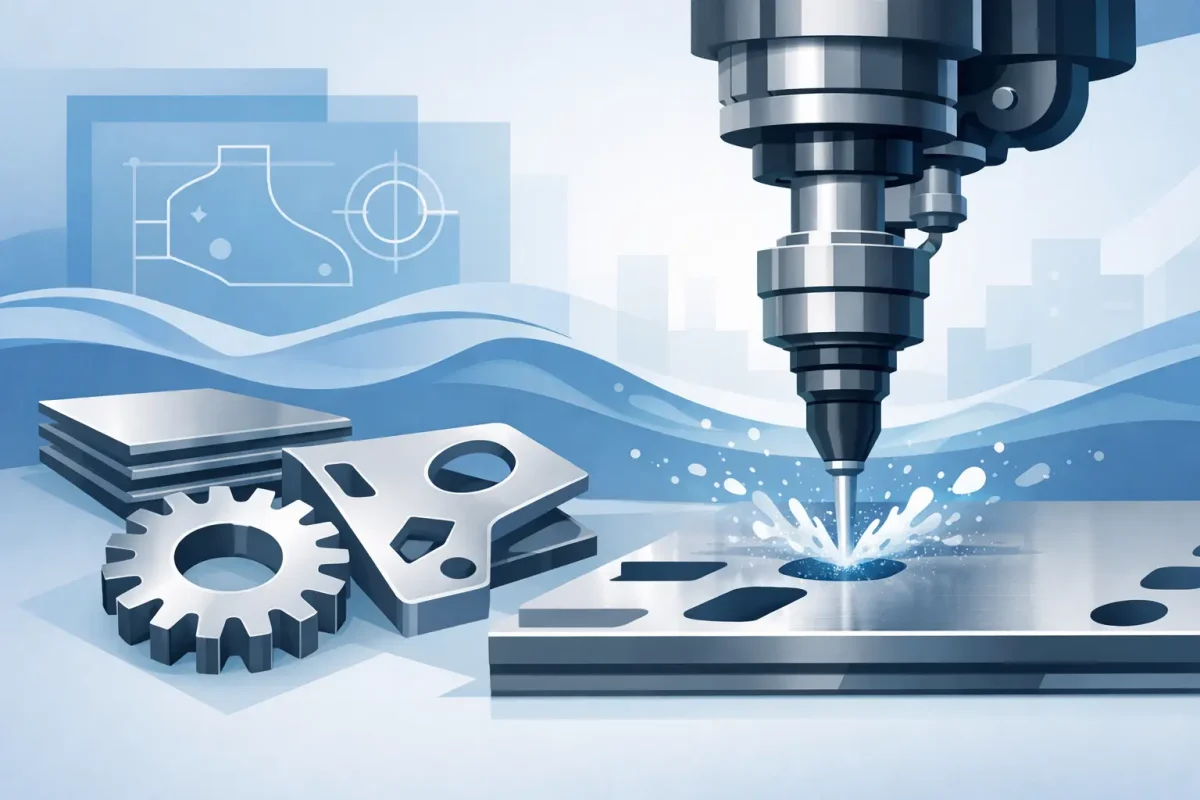
This is where having both laser and waterjet capability onsite is valuable. Waterjet cutting uses a high-pressure stream, up to 60,000 PSI, to cut without introducing heat into the workpiece. It is often the better option for heat-sensitive materials, thicker sections, certain non-metals or jobs where preserving the material’s original properties is essential. Laser and waterjet are not competing answers to every job. They are complementary processes, and selecting the right one can save time and rework.

Choosing between laser and waterjet cutting

For straightforward metal sheet parts where speed is a priority, laser is frequently the practical choice. It suits fabricated components that need accurate profiles and repeatable holes, particularly when a project has multiple identical parts or a tight programme.

Waterjet is often preferred when the material must remain cold throughout cutting. That includes jobs involving foam, rubber, stone, composites and materials that may distort, discolour or harden under heat. It is also well suited to thicker material and complex profiles where a heat-affected edge would create problems later.

The question is not which process is universally better. It is whether the part needs laser speed, a cold-cut edge, particular material compatibility or a specific finish. A reliable cutting supplier should ask about the full job rather than simply accepting a file and pressing start.

For example, an aluminium cover panel with accurately positioned cut-outs may be ideal for laser cutting. A stainless component that requires a cold edge before precision finishing may call for waterjet. An architectural screen may be laser cut efficiently, while a mixed-material design may need a different approach. The material tells part of the story. The final use tells the rest.

Prepare the file before material is cut

The fastest way to receive accurate parts is to provide a clean, final drawing. DXF and DWG files are commonly used for profile cutting because they allow the cutting path to be read directly. PDF drawings are useful for confirming dimensions, quantities, material and revision details, but a vector CAD file gives the clearest starting point for CNC programming.

Before sending a job for quotation, check that the drawing is drawn at full scale and that all dimensions are in millimetres. Make sure duplicate lines, open contours and unnecessary construction geometry have been removed. These small issues can create uncertainty in programming or produce a result that does not match what was intended.

It also helps to specify the material completely. “Stainless” is not enough if the project depends on a particular grade, finish or thickness. The same applies to aluminium and mild steel. Include the quantity required, whether material is supplied or needs to be sourced, and the deadline that matters to the job rather than a vague request for urgency.

For assemblies, think about fit-up before the cutting stage. Slots, tabs and hole sizes should account for coating thickness, bending, welding and the tolerances of mating parts. A nominally perfect drawing can still create a difficult assembly if it ignores powder coating build-up or the way heat from welding changes a component.

A useful pre-cut check covers four points:

  • final material type, grade and thickness
  • accurate CAD profile at 1:1 scale
  • quantity, revision number and critical dimensions
  • required edge finish, secondary work and delivery date

This information allows the cutting method, nesting and production schedule to be planned properly. It also makes quotes more accurate from the start.

Design details that affect cut quality

Fine features should be designed with the material in mind. A small hole in thick plate is not the same proposition as the same hole in thin sheet. As a general principle, holes, slots and narrow gaps become harder to cut cleanly as their width approaches the material thickness. If a feature is critical, flag it early so the cutting approach can be assessed before the material is committed.

Internal corners deserve attention too. A laser beam has a kerf, so an inside corner will naturally have a small radius rather than being perfectly square. Parts that need to slot tightly together may require reliefs or dog-bone details in the drawing. These details are quick to include in CAD and can prevent a frustrating amount of hand fitting later.

Nesting is another practical consideration. Efficiently arranging parts on a sheet reduces offcut and helps control material cost. It should not, however, compromise part identification, grain direction where relevant, or the amount of clearance needed for safe cutting. On high-value material, thoughtful nesting can make a meaningful difference to the overall project cost.

Local cutting support keeps projects moving

Outsourcing cutting is not just about gaining access to machinery. It is about having dependable capacity when your own workshop is busy, a job needs parts quickly or a complex profile is beyond what can be cut efficiently in-house. Local service also makes it easier to discuss a drawing, confirm material choices and organise delivery across metropolitan Adelaide or country South Australia.

Waterjet & Laser SA combines onsite CNC laser and waterjet cutting so customers can choose the process that suits the actual job. That flexibility is useful for fabricators managing mixed materials, builders working to installation dates and designers who need detailed work cut accurately without compromising the original concept.

The best time to raise a question about a tight tolerance, unusual material or difficult feature is before the first sheet is loaded. A short conversation at the drawing stage can turn a cutting order into parts that fit, finish cleanly and keep the next stage of the job moving.

Does Laser Cutting Warp Metal? The Real Answer

Does Laser Cutting Warp Metal? The Real Answer

A 3 mm stainless bracket can leave the laser bed flat and still move enough to create trouble when it reaches the press brake or assembly bench. So, does laser cutting warp metal? It can, particularly in thin sheet, long narrow parts and designs with dense cut-outs. But warping is not an automatic outcome of laser cutting. It comes down to how much heat enters the material, where it goes and how the part is supported while it cools.

For Adelaide fabricators, builders and project managers, that distinction matters. A distorted part can mean poor fit-up, extra straightening, rejected finishes and lost time on site. Choosing the right cutting process at the start is often the simplest way to protect accuracy further down the job.

Why laser cutting can warp metal

Laser cutting works by concentrating a high-energy beam into a very small area. The material melts or vaporises along the programmed cut path, while an assist gas removes molten material from the kerf. It is fast, accurate and highly effective for many steel, stainless steel and aluminium jobs.

The trade-off is heat. Metal immediately beside the cut expands as it becomes hot. The cooler material around it resists that expansion. Once the part cools, the uneven heating and cooling can leave residual stress behind. If the stress is high enough, the sheet may bow, twist, lift at an edge or pull a narrow feature out of plane.

This is heat distortion rather than a failure of laser-cutting accuracy. The machine may cut to excellent dimensional tolerances, yet the finished part may not sit flat because its shape has changed after the cut.

Which laser-cut parts are most likely to distort?

Material behaviour is never one-size-fits-all. A short, well-spaced profile in heavier mild steel may show no visible movement. A thin stainless panel with dozens of small apertures can react very differently.

Thin sheet has less stiffness

Thin material does not need much residual stress to move. Sheet around 1 mm to 3 mm is generally more susceptible than thicker plate, especially where the finished profile is large or has long unsupported areas. Even a slight bow can be noticeable in architectural panels, covers and folded components.

Long, narrow and detailed shapes concentrate the risk

Slender strips, fine tabs, narrow bridges and large internal cut-outs reduce the part’s ability to resist movement. Closely grouped holes or decorative patterns also put repeated heat into a small area. As the laser progresses, one side of the sheet may become hotter than the other, encouraging the material to pull or curl.

This is particularly relevant for intricate screens, grilles, signage and custom design work. A pattern may look balanced on screen, but its cutting sequence and the amount of material removed can make a real difference to flatness.

Stainless steel and aluminium need careful planning

Stainless steel retains heat more readily than mild steel, so thin stainless work can be prone to distortion where geometry is demanding. Aluminium conducts heat away quickly, which changes the cutting behaviour again. It can still distort, particularly when it is thin, has a large surface area or is held under stress before cutting.

Material condition matters too. Sheet can arrive with existing stresses from rolling, levelling, storage or prior fabrication. Cutting releases those stresses. In those cases, a part can move even if laser parameters are well controlled.

Restraint can help or make matters worse

Micro-joints or tabs hold a part in the parent sheet until the programme is complete, reducing the chance of a small part tipping or shifting. However, excessive restraint can hold heat and stress in place until removal, when the part may spring. Clamping and fixturing need the same judgement: enough support to control the work, without forcing already stressed material into an unnatural position.

How experienced operators reduce laser-cutting distortion

Good laser cutting is not simply a matter of loading a drawing and pressing start. The nesting layout, cut order, lead-ins, pierce locations, assist gas and machine settings all affect the amount and distribution of heat.

A capable operator will avoid cutting every feature in one corner of a sheet before moving on. Spreading cuts across the job allows local areas to cool. Internal features are commonly cut before the outside profile so the parent sheet supports the part for as long as possible. For heat-sensitive work, changing the sequence between repeated parts can also prevent heat build-up in one section of the nest.

Laser power and speed must suit the material grade and thickness. Too much energy, or a cut speed that is too slow, increases the heat-affected zone. Too little energy can create inconsistent cutting and unnecessary rework. The aim is not merely to get through the sheet. It is to produce a clean edge with the least practical heat input.

Part design can help as well. Where the application permits it, slightly wider bridges, more even feature spacing and sensible corner geometry reduce local stress concentration. A fabricator planning to fold or weld a panel should discuss that next operation before the cutting file is finalised. The best cutting approach depends on the finished component, not just the flat pattern.

When waterjet is the better choice

If flatness and material integrity are critical, waterjet cutting removes the heat question altogether. A CNC waterjet cuts with a high-pressure stream of water, often mixed with abrasive for metal. At pressures up to 60,000 PSI, it can cut steel, stainless steel, aluminium and many other materials without creating a heat-affected zone.

Because it is a cold-cut process, waterjet does not melt the edge or introduce thermal stress into the sheet. That makes it a strong option for thin material, heat-sensitive alloys, intricate shapes and parts that must remain flat for later folding, machining, welding or architectural installation.

Waterjet also suits materials that do not respond well to thermal cutting, including certain laminated, coated or mixed materials. Edge quality is clean and the material properties immediately beside the cut are preserved. For customers trying to minimise distortion and avoid secondary finishing, those benefits can outweigh a slower cutting speed on some jobs.

That does not mean waterjet replaces laser in every application. Laser cutting is often the more efficient choice for high-volume profiles in suitable sheet metal, particularly where speed is the priority and thermal movement is unlikely to affect the outcome. Waterjet can be slower and may not be the most economical process for every straightforward production run.

The practical question is not laser versus waterjet as a blanket rule. It is which process gives the required accuracy, edge finish, lead time and finished-part performance for this specific material and design.

Does laser cutting warp metal in every job?

No. Well-planned laser cutting regularly produces accurate, usable parts with minimal or no visible distortion. Heavier material, compact profiles, appropriate settings and intelligent nesting all reduce the risk substantially. For many brackets, base plates, machine components and production parts, laser cutting is the right answer.

The risk rises when several factors combine: thin sheet, a large panel, narrow features, dense perforations, complicated internal geometry and a requirement for exceptional flatness. If the part will be powder coated, folded, fitted into a frame or installed as a visible architectural element, even modest movement deserves attention before cutting begins.

A useful approach is to provide the cutting supplier with the material grade, thickness, finished use, quantity and any flatness-critical areas. Include information about subsequent folds, welds and surface finishes. That allows the operator to assess whether laser cutting is suitable, alter the cutting strategy or recommend waterjet before material and time are committed.

Get the process right before the first cut

Warping is usually preventable or manageable when the cutting method is matched to the job. At Waterjet & Laser SA, having both onsite laser and CNC waterjet capability means the decision can be based on the material and outcome required, rather than forcing every project through one process.

If a component needs fast, repeatable laser cutting, careful programming and experienced handling can keep distortion under control. If the job cannot tolerate heat distortion, cold-cut waterjet offers a precise alternative. Bring the drawing, material details and the finished-part requirements into the conversation early – it is the most reliable way to receive parts that cut cleanly, fit properly and are ready for the next stage of fabrication.

Waterjet Cutting for Accurate, Clean Parts

Waterjet Cutting for Accurate, Clean Parts

A plate can look perfectly usable after cutting, yet be compromised before fabrication even starts. Heat marks around a tight profile, a hardened edge on steel, or distortion in thin aluminium can add time and cost at the next stage. Waterjet cutting avoids those issues by using a high-pressure stream to cut material cold, producing accurate parts while preserving the material’s original properties.

For fabricators, builders, manufacturers and designers, that difference is practical. It can mean less edge clean-up, fewer fit-up problems and more confidence that a detailed drawing will arrive as a part ready for the job.

How waterjet cutting works

A CNC waterjet directs water at pressures up to 60,000 PSI through a very small nozzle. For softer materials such as foam, rubber and some plastics, a pure water stream may be enough. For metals, stone, glass and other hard materials, an abrasive is introduced into the stream. The water carries that abrasive through the material in a controlled cut.

The process is programmed from a supplied drawing, allowing repeated components, complex profiles, internal cut-outs and detailed patterns to be cut with consistent positioning. Because there is no heat-affected zone, the process does not melt the cut edge or introduce the thermal stress associated with heat-based cutting methods.

That does not mean every waterjet edge is identical. Cut quality depends on material, thickness, abrasive flow, cutting speed and the required finish. A faster cut may suit a structural blank that will be machined or welded later. A slower, finer cut may be the better choice for visible architectural work, precision components or parts that need to fit together cleanly. The right setting starts with understanding what the part must do after cutting.

Why waterjet cutting suits demanding materials

The key advantage of waterjet cutting is its cold-cut process. Metals retain their properties at the edge, making the method particularly useful where heat distortion, discolouration or hardening would create downstream problems. Thin stainless steel can remain flat, aluminium is less likely to show heat-related marks, and intricate steel shapes can be cut without placing heat into narrow sections.

Material range is another strength. A waterjet can cut steel, stainless steel and aluminium, but its value extends well beyond standard fabrication metals. Foam, rubber, plastics, ceramics, stone and glass can often be processed with the same technology, subject to the material’s condition and the required result. That versatility is useful for projects involving mixed materials or one-off design work where conventional metal-cutting methods are not suitable.

Waterjet cutting is also well suited to detailed geometry. Small holes, sharp internal corners, lettering, decorative screens, brackets, gussets, templates and custom panels can be produced directly from a digital file. The kerf is narrow, which helps retain detail and can reduce material waste when parts are nested efficiently on a sheet or plate.

For a job with high visual expectations, clean handling matters as much as the profile itself. Waterjet cutting does not produce the heat tint and slag commonly associated with thermal processes. Some materials may still need deburring or finishing depending on the cut specification, but the process provides a clean starting point for welding, polishing, coating or assembly.

Waterjet cutting versus laser cutting

Neither process is automatically the best choice. Waterjet and laser cutting each have clear advantages, and selecting the right one protects both lead time and budget.

Laser cutting is often the faster option for thinner sheet metal, particularly when producing high volumes of steel, stainless steel or aluminium parts. It can deliver excellent detail and a clean edge on suitable material. For repetitive sheet-metal components where speed is the priority, laser may be the most efficient process.

Waterjet is generally the stronger option when material thickness increases, when the material is sensitive to heat, or when the work involves non-metal materials. It is also a practical choice for parts where a heat-affected zone could interfere with machining, forming, welding or visual finish. A complex stainless steel component, for example, may be better waterjet cut if retaining edge condition is more valuable than cycle-time savings.

The decision also depends on the design. Fine features can be achieved with both methods, but the ratio between feature size and material thickness matters. Very small holes in thick plate, tight inside radii and delicate bridges should be reviewed before cutting. A capable cutting partner will assess the drawing and advise whether a minor design adjustment will improve accuracy, strength or value.

Having both processes available onsite makes this decision simpler. Rather than forcing every project through one machine, Waterjet & Laser SA can match the process to the material, thickness, edge requirement and programme timing.

Getting the best result from your drawing

Good cutting starts before the machine is switched on. A clear DXF or DWG file is generally the most efficient way to communicate a profile, hole locations and cut-outs. PDF drawings can be useful for reference, especially where dimensions, notes or finishes need clarification, but an editable vector file reduces interpretation and programming time.

Confirm the material grade and thickness early. “Stainless” or “aluminium” alone may not be enough if the part needs to be formed, welded, polished or used in a corrosive environment. The material’s supplied condition also matters. Plate that is already bowed, scratched or protected with film may need different handling than a standard sheet.

It is equally helpful to state which dimensions are critical. Not every edge needs the same tolerance, and specifying the important interfaces allows the cutting strategy to focus where it matters. If parts need to slot together, align with existing holes or sit against a finished surface, provide the mating detail where possible. This helps avoid assumptions that can become expensive once fabrication is underway.

For decorative work, think about the strength of the remaining material as well as the pattern itself. Narrow bridges may look effective in a drawing but can become vulnerable during transport, coating or installation. A small change to spacing, corner radius or material thickness can retain the design intent while producing a stronger finished panel.

Where cold-cut precision makes a difference

In general fabrication, waterjet cutting is a reliable way to produce accurate blanks, brackets, base plates, flanges and components ready for welding or machining. It gives workshops access to specialist cutting capacity without the capital cost, maintenance burden or operator requirements of running a waterjet in-house.

For construction and infrastructure work, the process supports custom profiles and thicker material where fit-up accuracy matters. Contractors can order components to drawing and keep site labour focused on installation rather than modifying poorly cut parts. For regional projects, dependable delivery planning is just as important as the cut itself.

Architectural and design-led projects benefit from the freedom of the process. Detailed screens, signage elements, furniture components, feature panels and custom motifs can move from concept to cut part without simplifying the design simply to suit a conventional cutting method. The possibilities are broad, but they remain grounded in material choice, structural needs and practical installation.

Waterjet cutting can also reduce avoidable waste. Efficient nesting makes better use of sheet and plate, while accurate first-time cutting reduces the likelihood of replacement parts. It is not a substitute for good design or material planning, but it is a sensible process for customers seeking precision without unnecessary heat input or excessive secondary work.

The most useful question is not whether waterjet is the best cutting method in every case. It is whether the finished part needs the cold-cut edge quality, material versatility and detail that waterjet provides. Start with the material, the drawing and what happens after cutting, and the right production path becomes much clearer.

Waterjet Cutting Benefits for Precision Projects

Waterjet Cutting Benefits for Precision Projects

A part that arrives warped, heat-marked or a few millimetres out can hold up an entire fabrication job. That is where the practical waterjet cutting benefits become clear. By cutting with a high-pressure stream of water and abrasive rather than heat, waterjet technology produces accurate parts while protecting the material properties that matter to your project.

For Adelaide fabricators, builders, manufacturers and designers, the result is straightforward: clean, reliable cut components that are ready for the next stage of work. Whether the requirement is a stainless steel bracket, aluminium panel, thick steel base plate, custom screen pattern or foam insert, the right cutting process can save time well beyond the cutting table.

Waterjet cutting benefits start with a cold-cut process

A CNC waterjet directs water at pressures up to 60,000 PSI through a small nozzle. For hard materials, an abrasive is introduced into the stream to cut through the workpiece with controlled force. Unlike thermal cutting methods, waterjet cutting does not create a heat-affected zone.

That distinction matters when material performance, finish and dimensional stability are non-negotiable. Steel does not suffer heat distortion around the cut. Stainless steel is not left with heat tint that may need additional treatment. Aluminium is less likely to warp, and materials that do not respond well to heat can be cut without being melted or burnt.

For a fabricator, this can mean less corrective work before welding, folding, machining or assembly. For an architectural project, it helps preserve the appearance of exposed materials. For a designer working with a specialised product, it means the cut is less likely to compromise the material itself.

Better material integrity where it counts

Heat can change more than the appearance of a cut edge. Depending on the material and process, it can affect hardness, create local stress and alter corrosion performance. A cold-cut waterjet avoids those issues, making it particularly useful for components where the edge will remain visible or where the finished part must perform consistently under load, weather or wear.

This is not to suggest waterjet is automatically the best process for every job. Laser cutting can be faster for many thin metal parts and is often an excellent production choice. The benefit of having both processes available is being able to choose based on the material, thickness, required finish and delivery deadline rather than forcing every part through one machine.

Precision without limiting the design

Waterjet cutting is valued for its ability to follow complex CNC profiles with high accuracy. Tight internal corners, detailed apertures, interlocking forms, lettering, curved patterns and repeat components can all be cut directly from a supplied drawing or developed design file.

This makes waterjet an effective choice when a job cannot be reduced to simple straight cuts. A decorative aluminium feature, a machine component with multiple holes, or a custom gasket pattern may all need precise geometry across every piece. Consistent cutting supports easier fit-up on site and reduces the time spent modifying parts by hand.

Precision also brings value to repeat work. Once a design is correctly prepared and programmed, replacement parts and future batches can be produced to the same profile. That is useful for maintenance teams, production businesses and fabricators managing staged installations.

Fine detail in thick materials

Thicker plate can make detailed work difficult with conventional methods. Waterjet is capable of cutting a broad range of thicknesses while maintaining the flexibility to create intricate profiles. The exact result depends on the material, thickness, tolerance and edge-quality requirement, but waterjet opens up options that can be impractical with manual cutting.

There are still design considerations. Very tight internal radii, tiny features and demanding tolerances should be discussed before production, particularly in thick material. A capable cutting partner will assess the drawing and recommend practical changes where needed, rather than cutting a design that is unlikely to perform as intended.

One process, a broad range of materials

Material versatility is one of the most useful waterjet cutting benefits. Waterjet can cut steel, stainless steel and aluminium, along with many non-metal materials such as foam, rubber, plastics, stone, tiles and composite products suited to the process.

That flexibility helps projects involving more than one material type. A shopfitter may need aluminium trim components and foam packing inserts. A manufacturer may require stainless steel covers alongside polymer guards. A designer may be testing a pattern across metal and decorative sheet material before committing to a larger run.

Because the process is cold, it is especially valuable for materials that can melt, burn, delaminate or release unpleasant fumes when cut with heat. Material handling remains important, and every material should be assessed for suitability, but the waterjet process gives customers more freedom to specify the material that best suits the application.

Clean edges can reduce downstream work

A quality cut is not only about the profile being correct. Edge condition affects how quickly a component can move into fabrication, finishing or installation. Waterjet cutting can deliver a clean edge with minimal burr, reducing the need for grinding and deburring on many jobs.

The required edge finish should be set at the quoting stage. Faster cutting may be suitable for concealed structural parts or components that will be welded and finished later. Slower, higher-quality cutting may be worthwhile for exposed architectural panels, precision components or parts that need to go straight into assembly.

That choice is commercially important. Paying for a premium edge where it will never be seen may add unnecessary cost. Selecting a fast cut for a visible feature panel can shift the cost to labour later. The best outcome comes from matching the cut quality to the real requirement of the finished part.

Less waste, smarter use of valuable material

Material costs add up quickly, particularly with stainless steel, aluminium and specialist sheet products. CNC nesting arranges parts efficiently on the sheet or plate, helping reduce offcuts and make better use of supplied material.

Waterjet’s narrow cutting stream also assists with efficient part placement. Combined with accurate programming, this can be beneficial for custom one-off work as well as repeated production batches. It does not eliminate waste altogether – every cutting process has kerf, handling constraints and practical spacing requirements – but careful nesting can make a meaningful difference to material yield.

For projects with expensive customer-supplied material, accuracy and handling are equally important. Correct identification, careful loading and clear communication around orientation, grain or finished faces help protect the material before a single cut is made.

Fast outsourcing without compromising control

Buying and running precision cutting equipment requires capital, trained operators, programming capability, maintenance and floor space. For many South Australian businesses, outsourcing is the more practical option, especially when workloads fluctuate or a project needs capabilities beyond the workshop’s usual setup.

A local cutting provider can turn a drawing into accurately cut parts while your team stays focused on fabrication, installation or production. The key is supplying clear information from the start: material grade and thickness, quantity, critical dimensions, tolerances, preferred edge quality and the required date.

Waterjet & Laser SA combines onsite CNC waterjet and laser cutting so customers can select the process that best supports their job. That is particularly useful when a project includes both thin sheet components where speed is a priority and thicker or heat-sensitive parts where cold cutting offers a clear advantage.

When waterjet is the right choice

Waterjet is often the strongest option when heat distortion is unacceptable, when material variety is high, or when detailed profiles are needed in thicker stock. It is also well suited to prototype work, custom fabrication and architectural pieces where accuracy and finish influence the final result.

Laser may be the better choice for high-speed cutting of thin metal sheet, particularly where the material and design suit the process. Sawing, machining or plasma cutting may also have a place depending on the geometry, budget and tolerance required. Good manufacturing decisions are not about choosing a favourite technology. They are about choosing the method that delivers the right part with the least avoidable rework.

Before releasing your next drawing, consider what happens after cutting. If the part needs to stay flat, retain its material properties, fit accurately and look clean without extensive finishing, waterjet cutting may be the step that keeps the whole project moving.

Metal Cutting Methods for Better Fabrication

Metal Cutting Methods for Better Fabrication

A cut edge can decide whether a component moves straight into fabrication or spends time on the bench being ground, dressed and reworked. For Adelaide fabricators, builders and project managers, metal cutting is not simply the first step in production. It affects fit-up, weld quality, material waste, lead times and the finished appearance of the job.

The right process depends on the material, thickness, tolerance, edge requirement and volume of parts required. CNC laser cutting and CNC waterjet cutting both produce accurate results, but they do so in very different ways. Choosing between them early can save time, reduce secondary work and protect the quality of valuable material.

Metal cutting starts with the job requirement

Before selecting a machine or sending through a drawing, consider what the finished part must do. A mild steel bracket for a production run has different requirements from a polished stainless steel architectural feature or a thick aluminium machine component.

Material type is a major factor. Steel, stainless steel and aluminium can all be cut accurately by laser, while waterjet is particularly useful where heat must be avoided or where the material is difficult to cut conventionally. Thickness matters too. Laser cutting is often the efficient option for thin to medium-gauge metal, especially where there are repeated profiles. Waterjet can handle substantial thicknesses and maintains material integrity because it is a cold-cut process.

The required edge condition should also be clear from the outset. If a part needs a clean profile ready for fabrication, powder coating or installation, the cut quality needs to suit that next stage. It is equally important to identify tight internal corners, small holes, intricate patterns and any areas where heat marks, distortion or hardening would create a problem.

Good cutting begins with good information. A clear CAD file, confirmed material grade and thickness, realistic tolerances, and a stated quantity allow the cutting process to be selected properly and quoted accurately.

CNC laser cutting for speed and repeatability

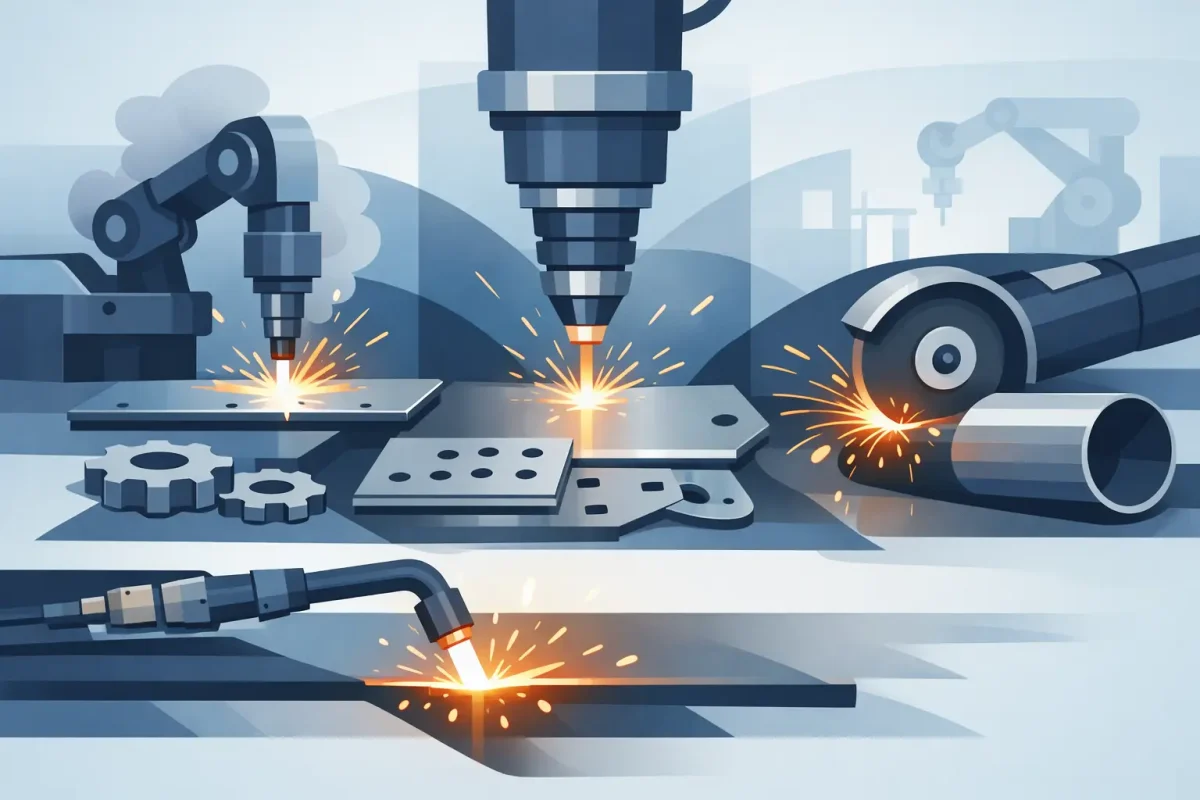
Laser cutting uses a focused beam to melt or vaporise material along a programmed path. Assisted gas clears the cut, allowing the machine to produce precise profiles at high speed. For many steel, stainless steel and aluminium jobs, it is an efficient choice for creating consistent parts with sharp detail.

Laser is particularly well suited to fabrication work where the material is relatively thin and the project includes many identical parts. Brackets, gussets, plates, covers, panels and folded-component blanks are typical examples. Once the drawing is programmed, CNC control delivers repeatable dimensions across the batch, helping fabricators maintain reliable assembly and fit-up.

Speed is a practical advantage, but it should not be considered in isolation. Laser cutting introduces heat to the material. On many jobs this is entirely acceptable, particularly when the part will be welded, folded or otherwise processed. On heat-sensitive material, however, the heat-affected zone can alter the edge condition or create slight distortion. The impact depends on material type, thickness, geometry and the job’s required finish.

Laser is also valuable for decorative metalwork. Fine perforations, detailed screen patterns, lettering and precise shapes can be cut efficiently when the design and material are suited to the process. For projects with a strong visual focus, clean programming and careful nesting help retain pattern consistency while reducing unnecessary waste.

Where laser cutting is usually the better fit

Laser cutting is often the first option when turnaround is critical, the job uses thinner sheet, or there is a high quantity of repeated parts. It provides a practical balance of speed, accuracy and cost for many everyday fabrication applications.

That said, thicker material or jobs requiring absolutely no thermal impact may point to waterjet instead. The fastest machine is not always the most efficient choice once secondary finishing, distortion risk and material value are taken into account.

Waterjet metal cutting where heat is not an option

Waterjet cutting uses a high-pressure stream of water, often mixed with abrasive garnet for metal, to erode the material along the programmed line. With pressure up to 60,000 PSI, the process cuts without creating a heat-affected zone.

That cold-cut capability is the defining benefit. There is no heat distortion, no burnt edge and no change to the material caused by thermal cutting. This makes waterjet a strong option for stainless steel, aluminium and other materials where preserving the original properties and appearance matters.

Waterjet also gives fabricators and designers useful flexibility. It can cut thick plate, intricate profiles and materials that may not suit laser processing. Beyond metal, the same process can be used on materials such as foam, making it useful where a project involves mixed material requirements or specialised components.

For a one-off custom part, an architectural detail or a complex component with fine internal features, waterjet can eliminate the need for multiple cutting methods. It is not necessarily the quickest choice for every thin-sheet production run, but it is often the right choice when edge integrity and versatility take priority.

Why cold cutting protects the finished part

Heat can change more than appearance. Depending on the metal and application, thermal processes can create edge hardening, discolouration or movement in the sheet. These issues may be minor, or they may become costly when parts need to align closely, retain a visible finish or perform in demanding service conditions.

A cold-cut waterjet edge helps reduce those concerns. This can mean less time correcting material before welding, machining or installation. It also gives designers more confidence when specifying intricate work in decorative stainless steel, aluminium features or thicker steel plate.

Accuracy is more than a machine specification

Precision cutting is not achieved by machinery alone. It relies on the complete process: reviewing the drawing, confirming the material, selecting the right cutting method, programming tool paths, nesting components efficiently and checking the completed parts.

Tolerances should be discussed in relation to the application. A simple structural plate may allow more variation than a component that must locate against machined holes or fit into an existing assembly. Over-specifying tolerance can add unnecessary cost, while under-specifying it can lead to assembly delays. The practical approach is to nominate the dimensions that genuinely control the fit and function of the part.

File preparation also makes a difference. DXF files are commonly preferred for two-dimensional cutting because they allow profiles, holes and cut-outs to be programmed directly. Drawings should be supplied at full scale, with duplicate lines removed and dimensions confirmed. Where there is uncertainty, a quick discussion before cutting is far cheaper than remaking parts after delivery.

Consider the work after the cut

The best metal cutting decision considers what happens next. Will the part be folded? Welded? Painted? Polished? Installed as a visible architectural feature? Each stage influences the preferred edge quality and process.

For example, laser-cut fabrication blanks may be ideal when the next operation is bending and welding in a busy workshop. A waterjet-cut stainless steel plate may be better for a visible installation where heat tint is unacceptable. Aluminium can be cut by either method, but the final application, thickness and finish requirement should guide the choice.

Material utilisation matters as well. Smart nesting places components efficiently within the sheet or plate, reducing offcuts and helping keep costs under control. This is especially worthwhile when working with premium stainless grades, aluminium plate or large-format material. Less waste supports both project budgets and more responsible material handling.

Local capacity keeps projects moving

Outsourcing cutting should make production easier, not create another point of uncertainty. Reliable lead times, clear communication and delivery capability matter when a fabrication team is coordinating labour, materials and site deadlines.

Waterjet & Laser SA combines onsite CNC laser and waterjet capability in Lonsdale, Adelaide, allowing the process to be matched to the actual job rather than forcing every order through one machine. That matters whether the requirement is a run of steel brackets, detailed aluminium panels, thick plate components or custom architectural work delivered across metropolitan Adelaide and regional South Australia.

The most useful question is not simply, “What is the cheapest way to cut this?” It is, “What process gives this part the best result at the point it needs to be used?” Bring the drawing, material details and end-use requirements to the conversation, and the right cutting method can keep the whole job on track.

Secret Link