
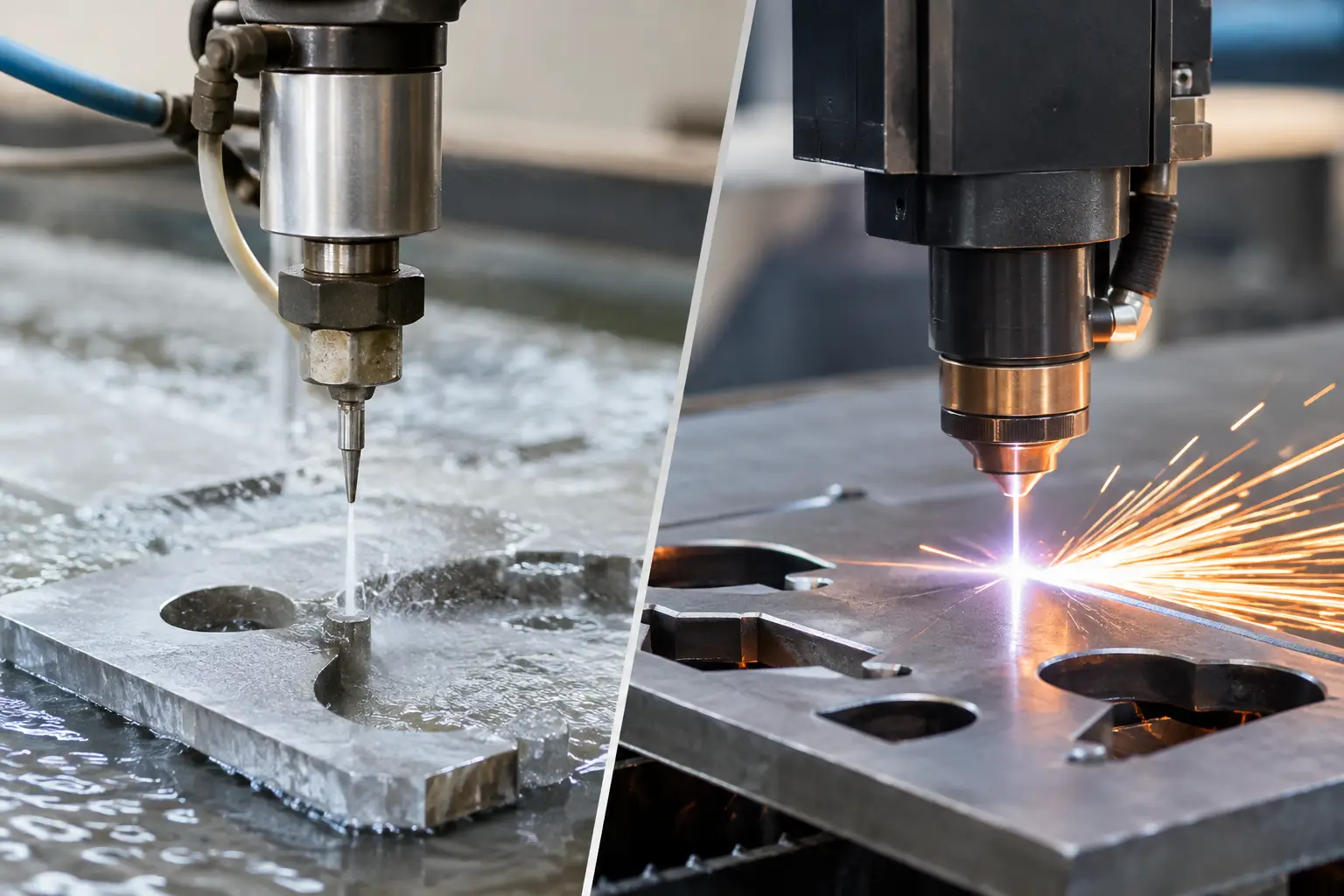
A warped aluminium bracket, a rough edge that needs grinding, or holes that have closed up after cutting can quickly turn an economical job into a costly delay. When comparing waterjet vs plasma for aluminium, the right process comes down to more than getting through the material. It affects fit-up, finishing time, part accuracy and how the aluminium performs in the next stage of fabrication.
Plasma is a fast, capable process for many conductive-metal jobs. Waterjet cutting takes a different approach, using a high-pressure stream of water and abrasive to cut without heat. For aluminium parts where edge condition, detail and material integrity matter, that difference is significant.
How plasma cutting handles aluminium
Plasma cutting uses an electrically conductive gas arc to melt metal, while a high-velocity gas stream removes the molten material from the cut. Aluminium is conductive, so plasma can cut it efficiently, particularly where production speed matters more than a fine finished edge.
For thicker plate, structural components and parts that will be welded, machined or ground after cutting, plasma can be a practical choice. It is generally faster than abrasive waterjet cutting on many aluminium thicknesses and can offer a lower cutting cost when tolerances are less demanding.
The trade-off is heat. Aluminium conducts heat extremely well, yet thin sheet and narrow features can still be affected by the concentrated thermal input of plasma. The cut edge can show a heat-affected zone, dross or oxide residue, and some parts may require secondary clean-up before fabrication or finishing.
Plasma cut quality also varies with material thickness, machine set-up, consumable condition and travel speed. A good operator and high-definition plasma system can produce useful results, but plasma is not usually the first choice for intricate profiles, tight internal corners or parts that need to come off the table ready for a visible finished application.
Waterjet vs plasma for aluminium: the key differences
The most useful comparison is not which method is universally better. It is which process reduces work and risk for your particular part.
Heat and material distortion
Waterjet is a cold-cut process. At pressures up to 60,000 PSI, the waterjet stream and abrasive cut through aluminium by erosion rather than melting. There is no heat-affected zone and no heat distortion caused by the cutting process.
That matters for thin aluminium sheet, close-tolerance parts, machined components and panels with detailed internal cut-outs. It also helps where flatness is important, such as covers, facias, architectural pieces and components that must sit cleanly against another surface.
Plasma introduces heat as part of the process. On a simple heavy plate profile, this may be acceptable. On lighter gauge aluminium or closely spaced features, it can create movement that needs to be corrected, or dimensions that need additional finishing work.
Edge quality and finishing work
A waterjet-cut aluminium edge is typically clean, square and free from thermal discolouration. The cut may have fine striations, depending on the required speed and quality setting, but it does not carry the hardened or heat-altered edge associated with thermal cutting.
This can remove steps from the job. If a part is heading to powder coating, anodising, assembly or a visible architectural installation, less grinding and edge dressing can mean a more consistent final result. Waterjet is also well suited to aluminium parts that need accurate slots, tabs, holes and interlocking profiles.
Plasma edges can be entirely suitable when the part will be welded, ground, painted or otherwise processed later. However, dross removal and edge clean-up should be allowed for in the production plan. If every part needs hand finishing before it can move forward, the initial speed advantage can narrow quickly.
Accuracy and design detail
Waterjet cutting is the stronger option for complex geometry. Fine internal shapes, tight radii, small holes, decorative patterns and detailed nested parts can be cut accurately without creating a large heat zone around the profile.
For fabricators, this supports better fit-up and repeatability. For designers and builders, it allows more freedom in aluminium screens, signage, feature panels and custom components where every line is visible. Waterjet can also cut material without needing a heat-sensitive protective process around the edge.
Plasma is more suited to larger, simpler profiles. It can handle circles, brackets, gussets and general plate shapes effectively, but kerf width, taper and thermal effects make it less appropriate where fine detail and close tolerances are central to the brief.
Thickness and cutting speed
Plasma’s main advantage is speed. On suitable aluminium plate, especially when parts are straightforward and a secondary operation is already expected, plasma can be an efficient production process.
Waterjet is usually slower, particularly in thicker materials and when a high-quality edge finish is specified. That slower cutting time needs to be weighed against the time saved in deburring, straightening, machining or remaking distorted parts. The best value is the finished part cost, not simply the machine cutting rate.
Waterjet also offers broad thickness capability and maintains its cold-cut benefits across a wide range of aluminium jobs. The practical limit will depend on the grade, thickness, profile detail and tolerance required, so it is worth reviewing the drawing before locking in a process.
Waste, safety and downstream work
Both methods can be programmed efficiently to nest parts and reduce material waste. Their workshop impacts differ, however. Plasma creates bright arc light, fumes and molten material, requiring suitable extraction and safety controls. It is an established process, but it is inherently thermal.
Waterjet produces no heat-affected zone, fumes or thermal distortion in the workpiece. The process uses water and abrasive garnet, with the spent material managed through the cutting system. For aluminium components that need clean handling and minimal alteration before the next operation, this is a useful advantage.
When plasma is the sensible choice
Plasma is not a poor choice for aluminium. It is often the sensible choice when the job involves simple profiles, moderate tolerances and sufficient thickness to make fast cutting valuable. It can suit structural parts, fabrication blanks and production work where the edge will be welded, ground or machined anyway.
It is also worth considering when lead time depends on processing a high volume of uncomplicated parts quickly. In these cases, a fabricator may accept a little dross or edge preparation because it is already built into the workflow.
The key is to be realistic about the final requirement. If a plasma-cut edge needs extensive manual work to meet the drawing, the process may not be delivering the expected saving.
When waterjet is the better aluminium cutting method
Choose waterjet when the part needs to retain its original material properties right to the cut edge. It is particularly effective for thin sheet, precision components, decorative work, panels with detailed cut-outs and aluminium that will be anodised, powder coated or installed without heavy edge finishing.
It is also a strong option for prototypes and short runs. Design changes can be applied directly to the cutting file, allowing intricate profiles to be produced without dedicated tooling. For custom fabrication, this provides flexibility without compromising accuracy.
Waterjet becomes especially valuable where several requirements meet at once: a complex shape, a clean visible edge, close tolerances and no tolerance for heat distortion. That combination is where a cold-cut process can prevent problems before they reach the workshop floor.
Specify the finished result, not only the cutting method
A good aluminium cutting quote starts with the outcome you need. Provide the material grade and thickness, drawing format, quantity, critical dimensions, visible faces and any next-stage processes such as folding, welding, coating or machining. These details help determine whether speed, precision, edge finish or heat control should take priority.
For Adelaide fabricators, builders, engineers and designers, Waterjet & Laser SA can assess the drawing and recommend the cutting process that makes practical sense for the job. Bringing the finished-part requirement into the discussion early is the simplest way to avoid unnecessary clean-up, rework and hold-ups later.