
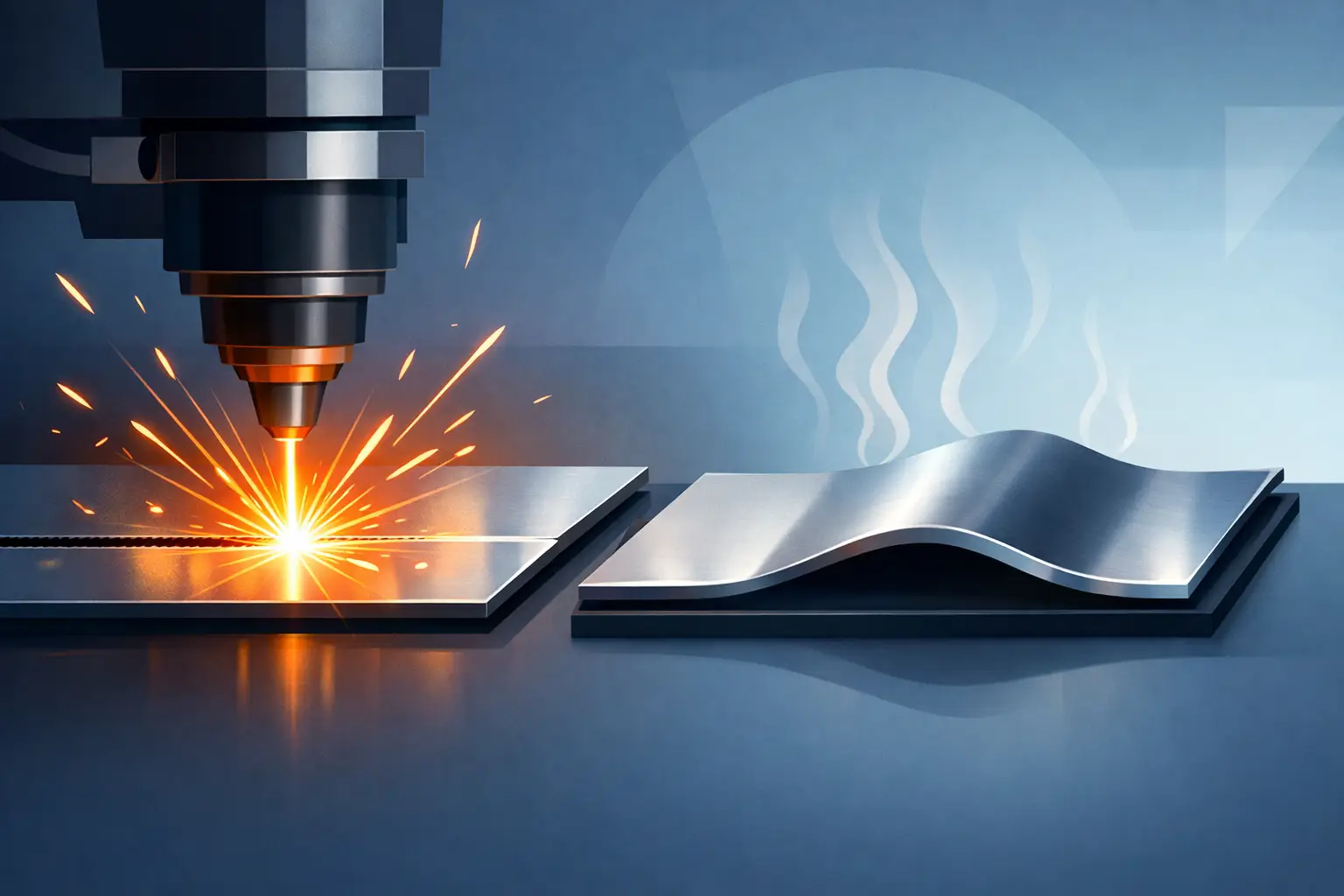
A 3 mm stainless bracket can leave the laser bed flat and still move enough to create trouble when it reaches the press brake or assembly bench. So, does laser cutting warp metal? It can, particularly in thin sheet, long narrow parts and designs with dense cut-outs. But warping is not an automatic outcome of laser cutting. It comes down to how much heat enters the material, where it goes and how the part is supported while it cools.
For Adelaide fabricators, builders and project managers, that distinction matters. A distorted part can mean poor fit-up, extra straightening, rejected finishes and lost time on site. Choosing the right cutting process at the start is often the simplest way to protect accuracy further down the job.
Why laser cutting can warp metal
Laser cutting works by concentrating a high-energy beam into a very small area. The material melts or vaporises along the programmed cut path, while an assist gas removes molten material from the kerf. It is fast, accurate and highly effective for many steel, stainless steel and aluminium jobs.
The trade-off is heat. Metal immediately beside the cut expands as it becomes hot. The cooler material around it resists that expansion. Once the part cools, the uneven heating and cooling can leave residual stress behind. If the stress is high enough, the sheet may bow, twist, lift at an edge or pull a narrow feature out of plane.
This is heat distortion rather than a failure of laser-cutting accuracy. The machine may cut to excellent dimensional tolerances, yet the finished part may not sit flat because its shape has changed after the cut.
Which laser-cut parts are most likely to distort?
Material behaviour is never one-size-fits-all. A short, well-spaced profile in heavier mild steel may show no visible movement. A thin stainless panel with dozens of small apertures can react very differently.
Thin sheet has less stiffness
Thin material does not need much residual stress to move. Sheet around 1 mm to 3 mm is generally more susceptible than thicker plate, especially where the finished profile is large or has long unsupported areas. Even a slight bow can be noticeable in architectural panels, covers and folded components.
Long, narrow and detailed shapes concentrate the risk
Slender strips, fine tabs, narrow bridges and large internal cut-outs reduce the part’s ability to resist movement. Closely grouped holes or decorative patterns also put repeated heat into a small area. As the laser progresses, one side of the sheet may become hotter than the other, encouraging the material to pull or curl.
This is particularly relevant for intricate screens, grilles, signage and custom design work. A pattern may look balanced on screen, but its cutting sequence and the amount of material removed can make a real difference to flatness.
Stainless steel and aluminium need careful planning
Stainless steel retains heat more readily than mild steel, so thin stainless work can be prone to distortion where geometry is demanding. Aluminium conducts heat away quickly, which changes the cutting behaviour again. It can still distort, particularly when it is thin, has a large surface area or is held under stress before cutting.
Material condition matters too. Sheet can arrive with existing stresses from rolling, levelling, storage or prior fabrication. Cutting releases those stresses. In those cases, a part can move even if laser parameters are well controlled.
Restraint can help or make matters worse
Micro-joints or tabs hold a part in the parent sheet until the programme is complete, reducing the chance of a small part tipping or shifting. However, excessive restraint can hold heat and stress in place until removal, when the part may spring. Clamping and fixturing need the same judgement: enough support to control the work, without forcing already stressed material into an unnatural position.
How experienced operators reduce laser-cutting distortion
Good laser cutting is not simply a matter of loading a drawing and pressing start. The nesting layout, cut order, lead-ins, pierce locations, assist gas and machine settings all affect the amount and distribution of heat.
A capable operator will avoid cutting every feature in one corner of a sheet before moving on. Spreading cuts across the job allows local areas to cool. Internal features are commonly cut before the outside profile so the parent sheet supports the part for as long as possible. For heat-sensitive work, changing the sequence between repeated parts can also prevent heat build-up in one section of the nest.
Laser power and speed must suit the material grade and thickness. Too much energy, or a cut speed that is too slow, increases the heat-affected zone. Too little energy can create inconsistent cutting and unnecessary rework. The aim is not merely to get through the sheet. It is to produce a clean edge with the least practical heat input.
Part design can help as well. Where the application permits it, slightly wider bridges, more even feature spacing and sensible corner geometry reduce local stress concentration. A fabricator planning to fold or weld a panel should discuss that next operation before the cutting file is finalised. The best cutting approach depends on the finished component, not just the flat pattern.
When waterjet is the better choice
If flatness and material integrity are critical, waterjet cutting removes the heat question altogether. A CNC waterjet cuts with a high-pressure stream of water, often mixed with abrasive for metal. At pressures up to 60,000 PSI, it can cut steel, stainless steel, aluminium and many other materials without creating a heat-affected zone.
Because it is a cold-cut process, waterjet does not melt the edge or introduce thermal stress into the sheet. That makes it a strong option for thin material, heat-sensitive alloys, intricate shapes and parts that must remain flat for later folding, machining, welding or architectural installation.
Waterjet also suits materials that do not respond well to thermal cutting, including certain laminated, coated or mixed materials. Edge quality is clean and the material properties immediately beside the cut are preserved. For customers trying to minimise distortion and avoid secondary finishing, those benefits can outweigh a slower cutting speed on some jobs.
That does not mean waterjet replaces laser in every application. Laser cutting is often the more efficient choice for high-volume profiles in suitable sheet metal, particularly where speed is the priority and thermal movement is unlikely to affect the outcome. Waterjet can be slower and may not be the most economical process for every straightforward production run.
The practical question is not laser versus waterjet as a blanket rule. It is which process gives the required accuracy, edge finish, lead time and finished-part performance for this specific material and design.
Does laser cutting warp metal in every job?
No. Well-planned laser cutting regularly produces accurate, usable parts with minimal or no visible distortion. Heavier material, compact profiles, appropriate settings and intelligent nesting all reduce the risk substantially. For many brackets, base plates, machine components and production parts, laser cutting is the right answer.
The risk rises when several factors combine: thin sheet, a large panel, narrow features, dense perforations, complicated internal geometry and a requirement for exceptional flatness. If the part will be powder coated, folded, fitted into a frame or installed as a visible architectural element, even modest movement deserves attention before cutting begins.
A useful approach is to provide the cutting supplier with the material grade, thickness, finished use, quantity and any flatness-critical areas. Include information about subsequent folds, welds and surface finishes. That allows the operator to assess whether laser cutting is suitable, alter the cutting strategy or recommend waterjet before material and time are committed.
Get the process right before the first cut
Warping is usually preventable or manageable when the cutting method is matched to the job. At Waterjet & Laser SA, having both onsite laser and CNC waterjet capability means the decision can be based on the material and outcome required, rather than forcing every project through one process.
If a component needs fast, repeatable laser cutting, careful programming and experienced handling can keep distortion under control. If the job cannot tolerate heat distortion, cold-cut waterjet offers a precise alternative. Bring the drawing, material details and the finished-part requirements into the conversation early – it is the most reliable way to receive parts that cut cleanly, fit properly and are ready for the next stage of fabrication.