
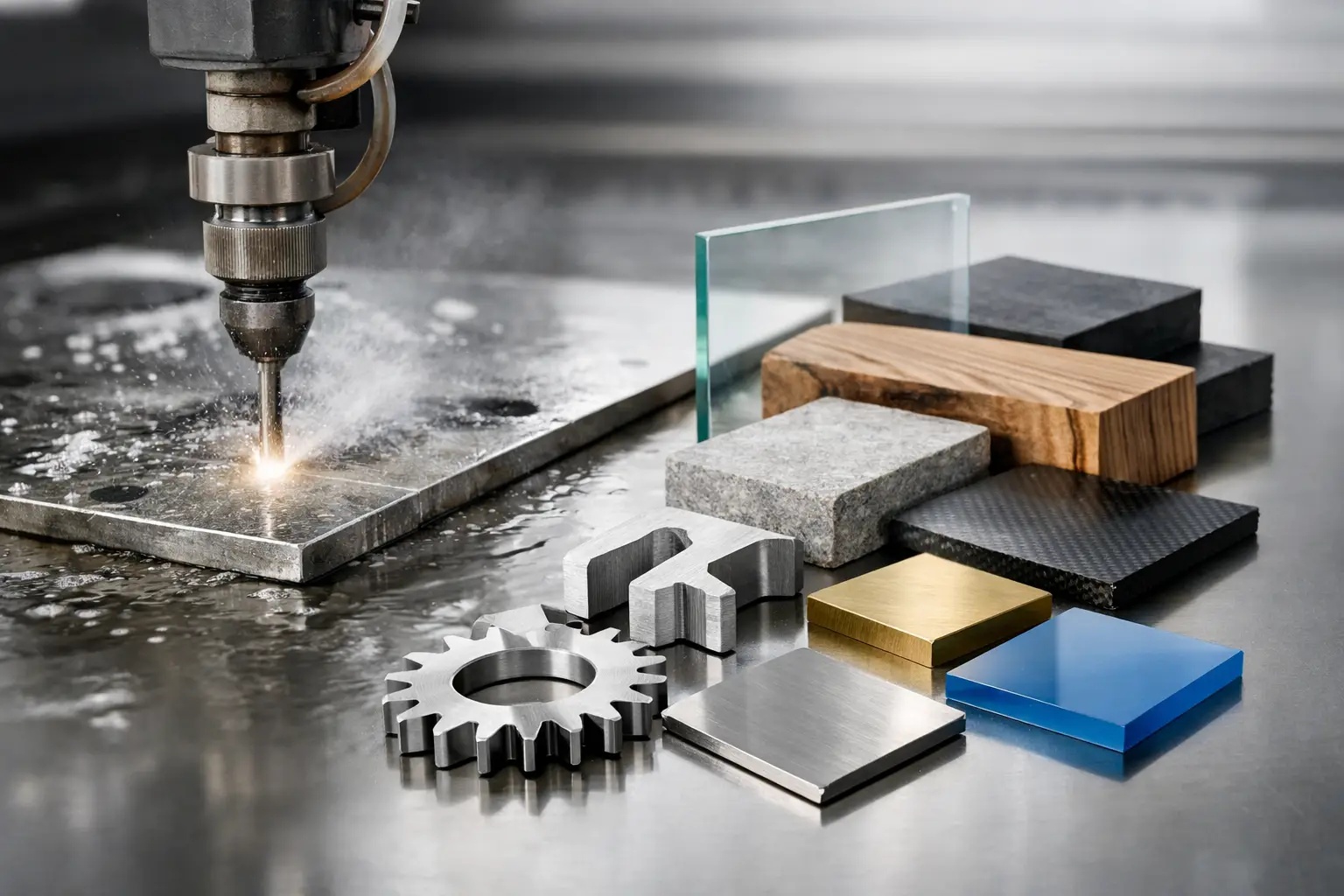
A distorted edge, heat-tinted stainless or a tile that cracks on the final cut can quickly turn good material into costly scrap. Selecting the best materials for waterjet cutting starts with understanding one key advantage: waterjet is a cold-cut process. It profiles material without creating a heat-affected zone, making it a practical choice where dimensional accuracy, clean edges and preserved material properties matter.
Waterjet cutting uses a high-pressure stream of water – up to 60,000 PSI – combined with abrasive garnet for hard materials. For softer materials, pure water may be enough. This flexibility allows one process to handle jobs that would otherwise need several machines, from thick steel brackets and aluminium panels to rubber gaskets, stone features and intricate architectural pieces.
What makes a material suitable for waterjet cutting?
Waterjet cutting is exceptionally versatile, but the best choice still depends on the material grade, thickness, required tolerance, edge finish and intended use. A part that will be welded, powder coated or machined afterwards may allow for a different cut quality than an exposed decorative panel or a precision-fitting component.
The process is especially valuable when heat could affect the job. Unlike thermal cutting methods, waterjet does not harden cut edges, burn protective films, create heat distortion or discolour sensitive materials. It also produces very little mechanical force on the workpiece, which helps when cutting brittle materials or fine internal details.
For many Adelaide fabricators, builders and designers, the decision is not simply whether a material can be cut. It is whether it can be cut accurately, economically and with an edge quality appropriate for the next stage of the project.
Best materials for waterjet cutting
Steel and mild steel
Mild steel is one of the most common waterjet applications. It suits brackets, base plates, gussets, machine parts, profiles and custom fabrication components. Waterjet produces a clean profile without the heat distortion associated with thermal processes, which can be useful on detailed parts, thicker plate and components that require accurate assembly.
For straightforward, high-volume profiles in thinner mild steel, laser cutting may be the faster and more economical option. However, waterjet becomes particularly attractive where thickness increases, where heat must be avoided, or where the part includes tight corners and intricate geometry. The absence of a heat-affected zone can also simplify subsequent machining or welding requirements.
Stainless steel
Stainless steel is an excellent candidate for waterjet cutting because appearance and corrosion performance often matter as much as profile accuracy. Architectural panels, food-grade equipment components, balustrade elements, marine parts and decorative features benefit from a cold-cut edge that is free from heat tint.
Waterjet can cut polished, brushed and coated stainless without exposing the surrounding material to cutting heat. Protective film can remain in place where suitable, helping to reduce handling marks before fabrication. For thin sheet and production quantities, high-definition laser cutting may offer better speed. For thick, sensitive or highly detailed stainless, waterjet is often the better fit.
Aluminium
Aluminium conducts heat rapidly and can be prone to distortion during thermal cutting, particularly in thinner sheet. Waterjet avoids that issue, delivering accurate profiles in aluminium plate, sheet, tread plate and custom panels without melting the cut edge.
This makes it well suited to transport, marine, automotive, building and fabrication work. It is also a strong option for intricate aluminium designs where narrow webs, small holes or detailed cut-outs need to remain flat and clean. The edge may have fine abrasive striations, especially in thicker material, so specify the required finish where parts will be visible or need close-fit assembly.
Brass, copper and other non-ferrous metals
Brass, copper and bronze can be difficult to process cleanly with some thermal cutting methods because of their heat conductivity and reflective properties. Waterjet does not rely on a thermal beam, so it can profile these materials without melting, burr formation or heat-related colour change.
Copper busbars, electrical components, signage, decorative inlays and custom hardware are typical examples. Material cost is often high for these metals, so accurate nesting and careful programming matter. Good preparation helps minimise offcuts and protects the value of the sheet or plate.
Stone, tile and pavers
Natural stone, porcelain tile, ceramic tile and pavers are among the materials where waterjet shows its creative and technical value. A waterjet can produce curved cuts, internal openings, mitres, inlays, logos and repeating patterns that would be difficult or risky to achieve with conventional saws.
Waterjet is particularly useful for high-value tiles and architectural finishes because it applies minimal physical stress. Even so, no brittle material is entirely risk-free. Existing flaws, veins in natural stone, material thickness and the size of narrow sections all influence the result. A test cut is sensible for unusual stone, fragile tiles or critical patterns.
Glass
Glass can be cut with waterjet when the right approach is used. It is suitable for selected architectural, artistic and industrial applications, including shaped panels, decorative pieces and openings. The key is managing the cut path, material support and edge requirements carefully.
Not every glass product behaves the same way. Tempered glass cannot generally be cut after tempering, while laminated and specialty glass require assessment before work begins. Waterjet can be an effective option, but glass projects should be reviewed individually to confirm that the material and design are appropriate.
Rubber, foam and gasket materials
For rubber, foam, cork, felt, plastics and gasket materials, pure-water cutting can produce highly accurate shapes without abrasive contamination. This is useful for seals, insulation, protective pads, packaging inserts, anti-vibration components and custom gaskets.
The lack of heat is a major benefit. Laser cutting can melt or harden some polymers and rubber products, while mechanical methods may compress, tear or pull soft material. A waterjet creates clean profiles with excellent repeatability, including bolt holes, slots and complex internal shapes.
Material density still matters. Very soft foam may need careful support to prevent movement, and some rubber compounds react differently depending on thickness and reinforcement. Providing the exact material specification helps determine the right cutting method and settings.
Timber, composites and specialty sheet
Waterjet cutting can also work well on timber, plywood, fibre cement, carbon fibre, fibreglass and selected composite sheets. It is useful for templates, feature panels, custom signs and specialised industrial components where intricate shapes are required.
The trade-off is moisture sensitivity. Waterjet introduces water to the cut, so untreated timber, MDF and some layered products may absorb moisture or show edge swelling. In these cases, laser cutting or CNC routing may be more appropriate. Composite materials also vary widely: some cut cleanly, while others need trial work to assess delamination, backing layers or water exposure.
Thickness, tolerance and edge quality matter as much as material
A material may be suitable for waterjet cutting, but its thickness and finish requirement determine how the job should be programmed. As thickness increases, cutting speed reduces and the natural taper or fine striation at the cut edge can become more noticeable. Quality settings can reduce these effects, although that increases cutting time and cost.
Be clear about what the part needs to do. A structural bracket hidden inside an assembly may only require a sound, accurate profile. A stainless feature panel, precision machine part or decorative screen may justify a finer cut quality. The drawing, quantity, thickness, material grade and critical dimensions should all be considered before production begins.
Small holes and narrow slots deserve particular attention. Their achievable size depends on material thickness and jet diameter. A knowledgeable cutting partner can advise whether a feature should be waterjet cut, drilled after cutting, or adjusted slightly to improve repeatability.
When waterjet is not the first choice
Waterjet is not automatically the best process for every job. High-volume runs of thin steel, stainless or aluminium often favour laser cutting because it is faster. Materials that must remain completely dry, such as certain timbers, paper products or moisture-sensitive laminates, may be better suited to another process.
There are also jobs where a saw, router or punch is the more economical choice. The right process should be selected around the finished part, not the machine. Having access to both CNC waterjet and laser cutting makes that decision more practical, especially when a project includes different materials or a mix of production and decorative components.
Getting the best result from your material
Good cutting starts before the sheet reaches the machine. Supply a clear drawing or CAD file where possible, confirm the exact grade and thickness, and identify any surfaces that must remain mark-free. If parts need to fit with existing components, include the critical dimensions and tolerances rather than relying on a general description.
For a one-off architectural piece, a sample or proof cut can prevent surprises. For production work, confirming nesting, material supply, cut quality and delivery timing upfront keeps the job moving. Waterjet & Laser SA works with fabricators, builders, manufacturers and designers across Adelaide and beyond to match the process to the material and the outcome required.
The best material choice is the one that arrives at the next stage of your project clean, accurate and ready to use. If the design is unusual, the material is expensive or the tolerance is critical, discuss it before cutting begins – that conversation is often where wasted time and material are avoided.