
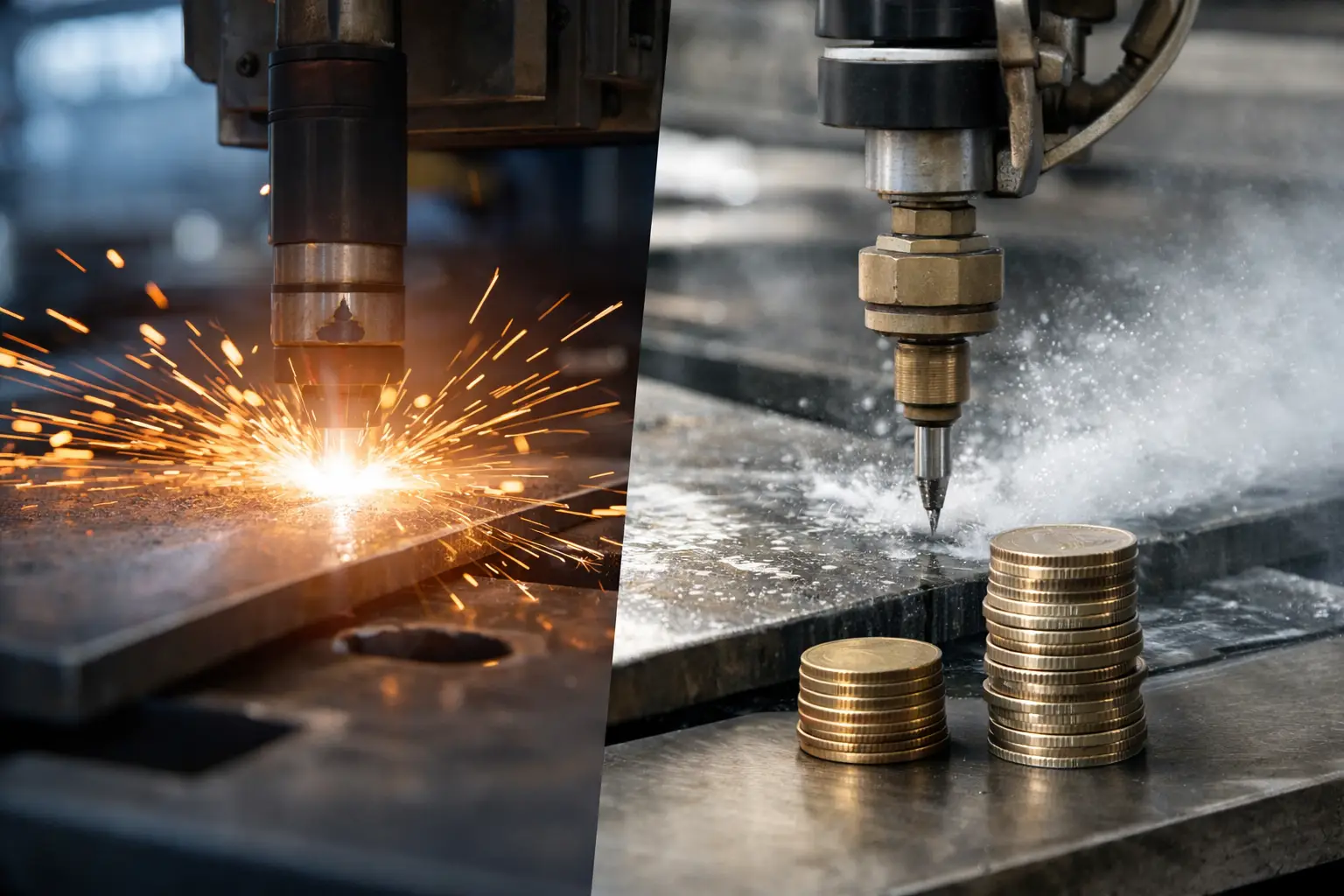
Which Cutting Method Costs Less?
A fast quote can be misleading when the part arrives warped, needs secondary finishing, or cannot meet the drawing tolerance. When customers ask which cutting method costs less, the useful answer is rarely just a per-minute machine rate. For most fabricated components, laser cutting costs less on thin-to-medium metal work where speed is the deciding factor. Waterjet can cost less overall when heat would damage the material, when the job involves non-metals, or when avoiding rework matters more than cutting speed.
The right process depends on the full job: material, thickness, cut length, number of pierces, tolerance, edge requirement, quantity and delivery timeframe. A lower initial cutting price is only a saving if the finished part is fit for fabrication, installation or assembly without extra work.
Why laser cutting is often the lower-cost option
Laser cutting is usually the economical choice for carbon steel, stainless steel and aluminium sheets within its effective cutting range, particularly when parts are relatively thin and quantities are moderate to high. A high-definition CNC laser moves quickly, produces accurate profiles and can nest many components efficiently on a sheet. That means fewer machine hours allocated to each part.
Speed is the major advantage. If you need dozens or hundreds of identical brackets, panels, gussets, tabs or machine components in thin sheet, laser cutting generally provides the lowest cost per part. Shorter cycle times also help when a fabrication schedule is tight. The work can move from cutting to bending, welding or assembly sooner.
Laser cutting also produces a narrow kerf. This allows efficient nesting and reduces material waste, which is significant on stainless steel, aluminium and other higher-value sheet products. When every square metre of material is accounted for, good nesting can make a noticeable difference to the final quote.
For straightforward sheet-metal profiles, laser-cut edges are usually clean enough for the next fabrication step. That can remove or reduce the need for manual trimming. On a part that will be powder coated, welded or concealed within an assembly, laser is often a highly practical and cost-effective answer.
The conditions that can add cost to laser work
Laser is not automatically the cheapest choice for every metal job. Thick plate slows the process considerably, and some materials need careful handling to achieve the required cut quality. Highly reflective metals, for example, may have limitations depending on thickness and specification.
Heat is the other consideration. Laser cutting creates a heat-affected zone at the cut edge. On many jobs this is not a concern. On thin material, narrow features, close tolerances or components that must remain perfectly flat, however, heat can introduce distortion or leave an edge condition that needs further treatment. If parts require straightening, machining or refinishing afterwards, the apparent saving can disappear.
When waterjet cutting costs less overall
Waterjet cutting uses a high-pressure stream of water, up to 60,000 PSI, combined with abrasive where required. It is a cold-cut process, meaning there is no heat-affected zone and no heat distortion. While waterjet is often slower than laser on thin sheet metal, it can be the more economical solution when that cold-cut advantage prevents downstream problems.
For thicker metal, intricate profiles and materials that are sensitive to heat, waterjet can reduce the total production cost. The edge remains free from thermal damage, making it suitable for components that need to retain their original material properties. This can be particularly valuable for engineering parts, precision fabrication work and pieces that will be machined or assembled after cutting.
Waterjet also has much wider material versatility. It can accurately cut steel, stainless steel, aluminium, tile, pavers, stone, rubber, foam, gasket materials, timber and many other products that are unsuitable or less practical for laser processing. A single process that handles mixed materials can simplify a project and avoid the cost of organising multiple suppliers.
Consider a custom gasket run, a decorative stone inlay or a thick aluminium component with fine internal detail. Laser may not be appropriate for one or more of those materials, while waterjet can produce the profile without burning, melting or discolouring the edge. In that situation, comparing only the hourly rate misses the point. Waterjet is less expensive because it delivers the required finished result in one cutting process.
Waterjet costs to factor into a quote
Waterjet cutting has its own cost drivers. Abrasive consumption, cutting speed and cut thickness all affect the price. A long, intricate profile in thick plate takes time, especially where the drawing includes many small holes, sharp corners or internal cut-outs. Tighter tolerances may also call for a slower, higher-quality cutting setting.
That does not make waterjet a premium-only process. It simply means the value is strongest where precision, material integrity and versatility are essential. For a thin mild-steel blank with simple geometry, waterjet may be more than the job requires. For a heat-sensitive or non-metal part, it may be the process that avoids unnecessary risk and expense.
Compare the total cost, not only the cutting rate
The most useful comparison starts with the finished component rather than the machine. Ask what happens after cutting. Does the edge need deburring? Will the material be bent, welded, polished, painted or machined? Could heat distortion affect fit-up? Are there costly consequences if a part is out of tolerance?
A laser-cut component may have the lowest direct cutting charge, but a waterjet-cut equivalent could be cheaper once secondary operations are included. Conversely, specifying waterjet for a large batch of uncomplicated thin steel parts may add cost without delivering a meaningful benefit over laser.
Material yield belongs in the same calculation. Efficient nesting reduces offcuts, and it becomes increasingly important on high-value materials or large production runs. Part geometry also matters. A design with dozens of pierces, tiny holes and excessive cut length will cost more with either process than a simplified profile that achieves the same function.
Quantity changes the answer as well. For a one-off prototype, programming, setup and material handling are a larger share of the job cost. For repeat production, cutting speed, nesting efficiency and consistency take over. Providing an accurate drawing early helps a cutting provider select the best method and quote from the actual requirements rather than assumptions.
Choosing the lower-cost method for common jobs
For thin mild steel brackets, cabinets, base plates and production sheet-metal parts, laser cutting will commonly provide the better price and faster turnaround. It is built for speed, repeatability and efficient use of sheet.
For thick plate components, detailed stainless steel profiles, precision aluminium parts and work where flatness is critical, waterjet deserves close consideration. Its cold-cut process can protect the part from heat-related movement and reduce finishing requirements.
For rubber, foam, gasket materials, tile, stone, timber and mixed-material projects, waterjet is generally the practical option. It opens up designs that laser cannot process in the same way, while delivering a clean, accurate profile.
Architectural work often sits between the two. Laser is an excellent option for metal screens, signage and decorative steel features where speed and detail are needed. Waterjet may be preferable for intricate inlays, thicker material, stone features or designs combining very different materials.
Get the process matched to the part
The lowest-cost cutting method is the one that produces a compliant part with the least total time, waste and rework. Sending through the material grade, thickness, quantity, tolerances, finish expectations and a clear drawing gives the cutting team the information needed to make that call confidently.
With onsite CNC laser and waterjet capability, Waterjet & Laser SA can assess both options against the same job rather than forcing a project into one process. That means Adelaide fabricators, builders, manufacturers and designers can choose on practical value: accurate parts, dependable turnaround and a result ready for the next stage of work.
Before approving a quote, look beyond the first line item. A well-matched cutting process protects your material, your schedule and the quality of everything that follows.