
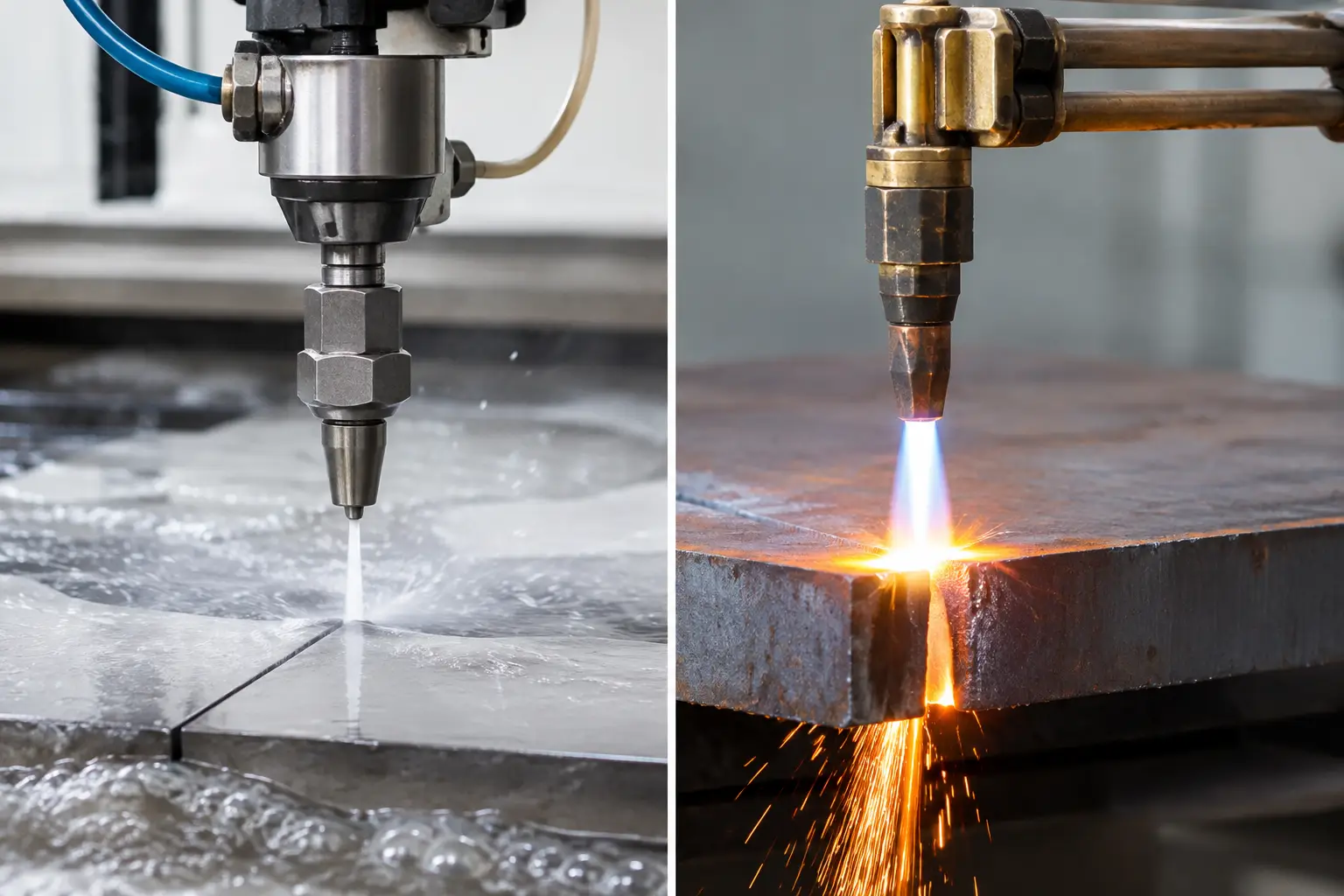
A plate profile that arrives warped, heavily scaled or a few millimetres out can hold up an entire fabrication job. In the decision between waterjet versus oxy fuel cutting, the right process depends less on which method is “best” and more on the material, tolerance, edge requirement and production schedule.
Oxy fuel remains a practical, cost-effective choice for many heavy carbon steel applications. Waterjet brings a very different advantage: a high-pressure, cold-cut process capable of accurate, intricate profiles across a far wider range of materials. Knowing where each process fits helps avoid unnecessary secondary work, rejected parts and delays on site.
Waterjet versus oxy fuel cutting: the core difference
Oxy fuel cutting uses a flame to preheat steel to its ignition temperature, followed by a high-pressure stream of oxygen that oxidises and removes the metal. It is a thermal process. Its strength is cutting thicker mild steel plate efficiently, especially where fine detail and a machined-quality edge are not essential.
Waterjet cutting uses water pressurised to as much as 60,000 PSI. For hard materials such as steel, stainless steel, aluminium, stone and tile, an abrasive is added to the water stream. The resulting jet erodes the material along the programmed cutting path rather than melting or burning it.
That cold-cut distinction is significant. Waterjet does not create a heat-affected zone, so the material adjacent to the cut retains its original properties. There is no heat distortion, hardening at the edge or oxide scale caused by the cutting process.
Material suitability is the first decision
Oxy fuel is principally a carbon steel process. It works well on mild steel because the oxidation reaction supports the cut. Stainless steel, aluminium and most non-ferrous metals do not respond in the same way, which makes conventional oxy fuel unsuitable for those materials.
Waterjet has much broader material flexibility. One job may involve stainless brackets, aluminium panels, rubber gaskets, ceramic tiles and timber components, all cut from a digital file with no change to a heat-based method. This is particularly useful for fabricators and builders handling mixed-material projects, or designers combining metal with architectural finishes.
For mild steel only, both processes can be viable. Once the job involves stainless, aluminium, copper, rubber, foam, glass, tile, pavers or composite materials, waterjet is usually the more practical option.
When oxy fuel is a sensible choice
Oxy fuel earns its place when the work is straightforward and heavy-duty. Large, thick mild steel components with generous tolerances are common examples. Base plates, structural blanks and parts that will be welded, machined or heavily dressed afterwards can often suit oxy fuel well.
It can also be an efficient option where edge appearance is secondary and the profile contains mostly long, simple cuts. If a fabricator will remove edge material during a later machining or welding preparation stage, paying for a finer cutting process may not add enough value.
The trade-off is that heat has to go somewhere. The cut edge can show scale and a heat-affected zone, while thinner sections and detailed profiles may be more vulnerable to movement or distortion. Dross and edge taper can also require clean-up before coating, assembly or precision fit-up.
Where waterjet has the advantage
Waterjet is well suited to parts that need to be accurate from the cutting table, not corrected later. It can produce detailed internal cut-outs, tight radii, slots, tabs, decorative patterns and complex nesting without thermal stress on the material.
That matters for stainless steel components that need to remain flat, aluminium parts intended for clean fabrication, and decorative screens where the profile itself is the finished feature. It also matters when the part has a protective film, delicate surface or heat-sensitive laminate that could be affected by a flame process.
The edge produced by waterjet is clean and free of thermal damage. Depending on the requested cutting quality and material, a waterjet edge may still show fine striations, but it is typically ready for the next operation without the scale associated with oxy fuel cutting. For many jobs, reducing deburring, grinding and rework offsets part of the initial cutting cost.
Accuracy, detail and edge quality
If the part needs to fit another component accurately, the cutting method should be chosen around that requirement early. Oxy fuel is capable of dependable production cutting, but its kerf, heat input and edge condition make it less suitable for highly detailed or close-tolerance work.
Waterjet is CNC controlled and follows the programmed geometry with high precision. Fine features can be cut without introducing heat into narrow webs or closely spaced holes. The process is particularly valuable for prototype work, replacement parts and custom fabrication, where a poor fit can cost more than the cut itself.
There is a practical point here: cutting accuracy is only as useful as the drawing supplied. A clean DXF, DWG or other production-ready file helps the operator achieve the intended result. Where a drawing requires checking, material allowance or nesting advice, sorting that out before cutting protects both lead time and budget.
Thickness and speed: avoid broad assumptions
Oxy fuel has a strong reputation for thick mild steel because it can cut substantial sections economically. For large volumes of simple heavy plate, it may be the preferred production method.
Waterjet also cuts thick materials, but cutting speed changes with thickness, material hardness and the selected edge finish. A thicker plate or a higher-quality edge requires more cutting time. This does not make waterjet the wrong choice – it means the value needs to be assessed against the finished-part requirement.
For example, a thick mild steel blank with rough tolerances may favour oxy fuel. A thick stainless steel part with holes, complex contours and no tolerance for heat distortion clearly points towards waterjet. A thick aluminium component requiring clean edges is another case where waterjet is often worth the additional process time.
Cost means more than the price per metre
The lowest quoted cutting rate is not always the lowest job cost. Oxy fuel can be economical at the cutting stage for suitable steelwork, yet the part may need grinding, scale removal, straightening or additional machining before it can be used.
Waterjet cutting can have a higher direct cost, particularly on very thick material, because abrasive and machine time are part of the process. However, it can lower downstream costs by supplying accurate, cold-cut parts that require less finishing. It also enables materials and profiles that oxy fuel cannot process at all.
When comparing quotes, consider the full job: material utilisation, edge preparation, tolerance, flatness, coating requirements, assembly time and the cost of a late replacement part. These details are often where the real difference appears.
Choosing the process for your next job
Start with the material. If it is not mild steel, oxy fuel is generally off the table. Next, look at the required edge condition and tolerance. Parts that are visible, intricate, heat-sensitive or ready for immediate assembly usually benefit from waterjet.
Then assess thickness, quantity and profile complexity. A run of simple, heavy mild steel blanks may suit oxy fuel. A smaller batch of complex parts, mixed materials or precision components is a stronger waterjet application. There is no advantage in forcing every job through one process when the part requirements call for another.
For Adelaide fabricators, builders and manufacturers, local access to experienced CNC cutting support can make this choice simpler. Waterjet & Laser SA can review the material, drawing and finished-part requirement before production, helping ensure the selected process matches the job rather than creating extra work after delivery.
The most useful question is not whether waterjet or oxy fuel is superior. Ask what the component must do after it is cut. If it needs to remain flat, fit precisely, look clean or preserve the integrity of the material, choosing a cold-cut waterjet process from the outset can save time where it matters most.