
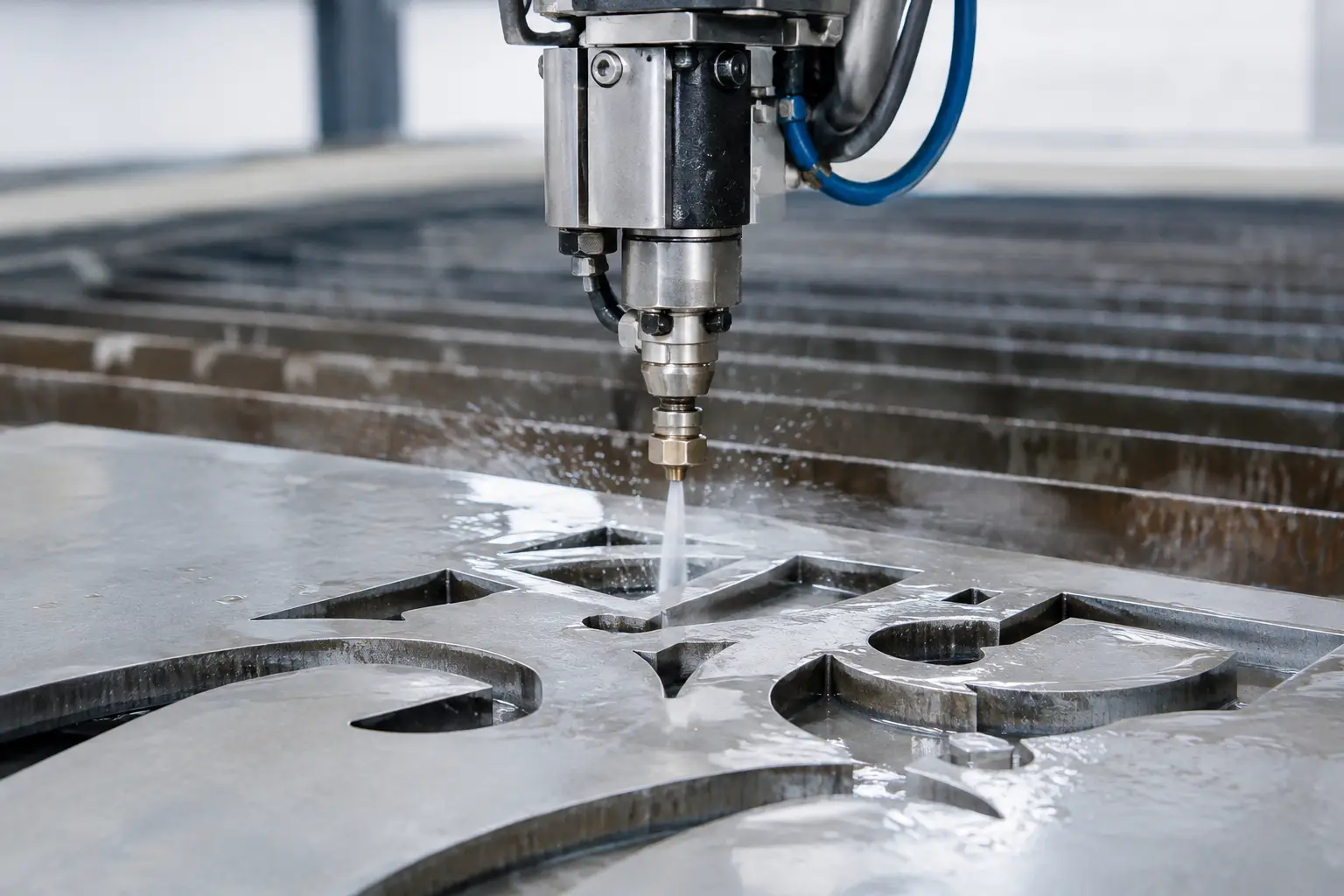
A worn gasket can stop a production line. A distorted stainless bracket can hold up a fit-out. A decorative panel with rough internal corners can undermine an otherwise excellent build. The best waterjet cutting project examples show why process selection matters just as much as the drawing: accurate parts, clean edges and material that remains true to its original condition.
Waterjet cutting uses a high-pressure stream of water, often mixed with abrasive, to cut directly through a broad range of materials. With pressures up to 60,000 PSI, it can profile complex shapes without creating a heat-affected zone. That cold-cut advantage is particularly valuable where heat distortion, hardening or discolouration would create extra work later in fabrication.
Waterjet Cutting Project Examples Across Industry
Precision steel brackets and mounting plates
Fabricators regularly need brackets, base plates, gussets and machine mounts that are ready for drilling, folding, welding or assembly. Waterjet cutting is well suited to detailed steel profiles with internal holes, slots and tight radii, particularly when a job includes varied thicknesses or an awkward layout that is not economical to machine conventionally.
The practical benefit is consistency across a batch. Instead of hand marking and cutting each component, the profile is programmed from the supplied drawing so repeat parts are cut to the same dimensions. Final tolerance requirements should always be discussed at quoting stage, as material thickness, profile geometry and edge-finish expectations all influence the best cutting strategy.
Stainless steel components for food, marine and architectural work
Stainless steel rewards careful handling. Heat from some cutting methods can leave tinting or affect the edge condition, creating additional cleaning and finishing requirements. Waterjet processing avoids thermal distortion, making it a useful option for stainless components where flatness and appearance matter.
Typical projects include splashbacks, benchtop apertures, access covers, equipment guards, marine fittings and intricate architectural details. For visible parts, the cut edge can be specified with the intended finish in mind. A component destined for polishing has different requirements from a concealed internal plate, and identifying that early helps control cost without compromising the result.
Aluminium panels and lightweight fabricated parts
Aluminium is common in transport, signage, machinery guarding and fabricated assemblies because it is light and corrosion resistant. It can also be susceptible to heat-related distortion, especially in thinner sheet. A waterjet’s cold-cut process helps preserve the material’s shape while delivering clean profiles for panels, covers, brackets and custom enclosures.
For projects requiring larger quantities of straightforward aluminium shapes, laser cutting may be the faster option. For thicker aluminium, intricate geometry, mixed materials or jobs where no heat input is preferred, waterjet can be the better fit. Having both processes available means the decision can be based on the actual part rather than forcing every job through one machine.
Mining and industrial wear components
In mining, quarrying and heavy industry, downtime makes replacement parts urgent. Waterjet cutting can produce wear plates, liners, shims, guards, spacer packs and replacement profiles from suitable steel, rubber and other hard-wearing materials. It is also useful where a component needs detailed holes or cut-outs that would be difficult to achieve with basic oxy cutting.
A clear sample, marked-up sketch or existing part can be enough to begin a conversation where original drawings are unavailable. Critical dimensions, mating faces and hole locations should be identified before cutting. For urgent breakdown work, accurate information at the start reduces the chance of a part arriving on site that needs alteration before it can go into service.
Rubber, foam and gasket sets
Not every precision-cut part is metal. Waterjet cutting is highly effective for rubber, foam, cork, fibre and gasket materials because it applies no heat that could melt, burn or compress the material at the edge. This makes it suitable for sealing components, insulation profiles, protective pads, vibration-control parts and custom packing pieces.
Nested cutting can also make a material sheet go further, reducing offcuts on repeat jobs. Where a gasket must seal around bolt holes, ports or irregular openings, a digitally cut profile provides a more reliable result than hand trimming. For production runs, retaining the approved file makes reordering straightforward and keeps the profile consistent.
Tiles, stone-look products and fit-out details
Builders, tilers and designers often face the same limitation: a standard saw handles straight cuts well but struggles with internal shapes, precise curves and detailed openings. Waterjet cutting can create accurate cut-outs in tiles and suitable architectural materials for floor wastes, pipe penetrations, inlays, lettering and feature patterns.
This is where drawings need to account for installation, not just appearance. Allowance for grout lines, substrate movement, the final fixing method and any visible edge treatment should be considered before the material is cut. A well-prepared file turns a complex visual idea into a practical component that can be installed with confidence.
Decorative screens, signage and custom design pieces
Some of the most recognisable waterjet cutting project examples are created for visual impact. Decorative panels, feature inserts, house numbers, branded signage, garden art and patterned metal screens all rely on accurate detail. Waterjet is particularly useful when the design includes fine shapes in material that must remain flat and free of heat marks.
Design freedom still needs practical boundaries. Very narrow bridges between cut-outs can weaken a panel, while tiny features may not suit every material thickness. A capable cutting provider can flag these issues before production and suggest small changes that preserve the look while improving strength, cut quality and installation performance.
Choosing Waterjet or Laser for Your Project
Waterjet is not automatically the best process for every profile. High-definition laser cutting is often an efficient choice for suitable sheet-metal jobs where speed and a fine edge are the priority. Waterjet comes into its own with heat-sensitive materials, thicker stock, non-metal materials, mixed requirements and profiles where avoiding thermal effects is essential.
The strongest approach is to assess the material, thickness, quantity, edge expectation and purpose of the finished part. A hidden steel support, a polished stainless feature, a rubber seal and a decorative aluminium panel may all need different settings or even different technologies. Selecting the right process at the outset helps prevent avoidable secondary work and delays.
What to Provide Before Cutting Begins
A precise quote and a smoother production process start with usable project information. A DXF file is ideal for profile cutting, although a clear PDF, dimensioned sketch or sample part can assist with many custom jobs. Include the material type and thickness, quantity required, key dimensions, required tolerances and whether the part will be folded, welded, painted, polished or installed as a visible finish.
It also helps to identify which dimensions are critical. Not every edge needs the same level of accuracy, and treating every feature as critical can add time without adding value. If parts must fit existing equipment, provide the relevant mating dimensions rather than relying only on an overall measurement.
For Adelaide fabricators, builders, manufacturers and designers, local cutting capacity can make a real difference when schedules change or replacement parts are needed quickly. Waterjet & Laser SA can assess the drawing and material requirement, then recommend a cutting method that suits the job rather than a one-size-fits-all process.
The next time a project calls for more than a straight cut, start with the finished part in mind: how it must fit, what it must withstand and what it should look like when installed. That is where a well-chosen cutting process earns its value.