
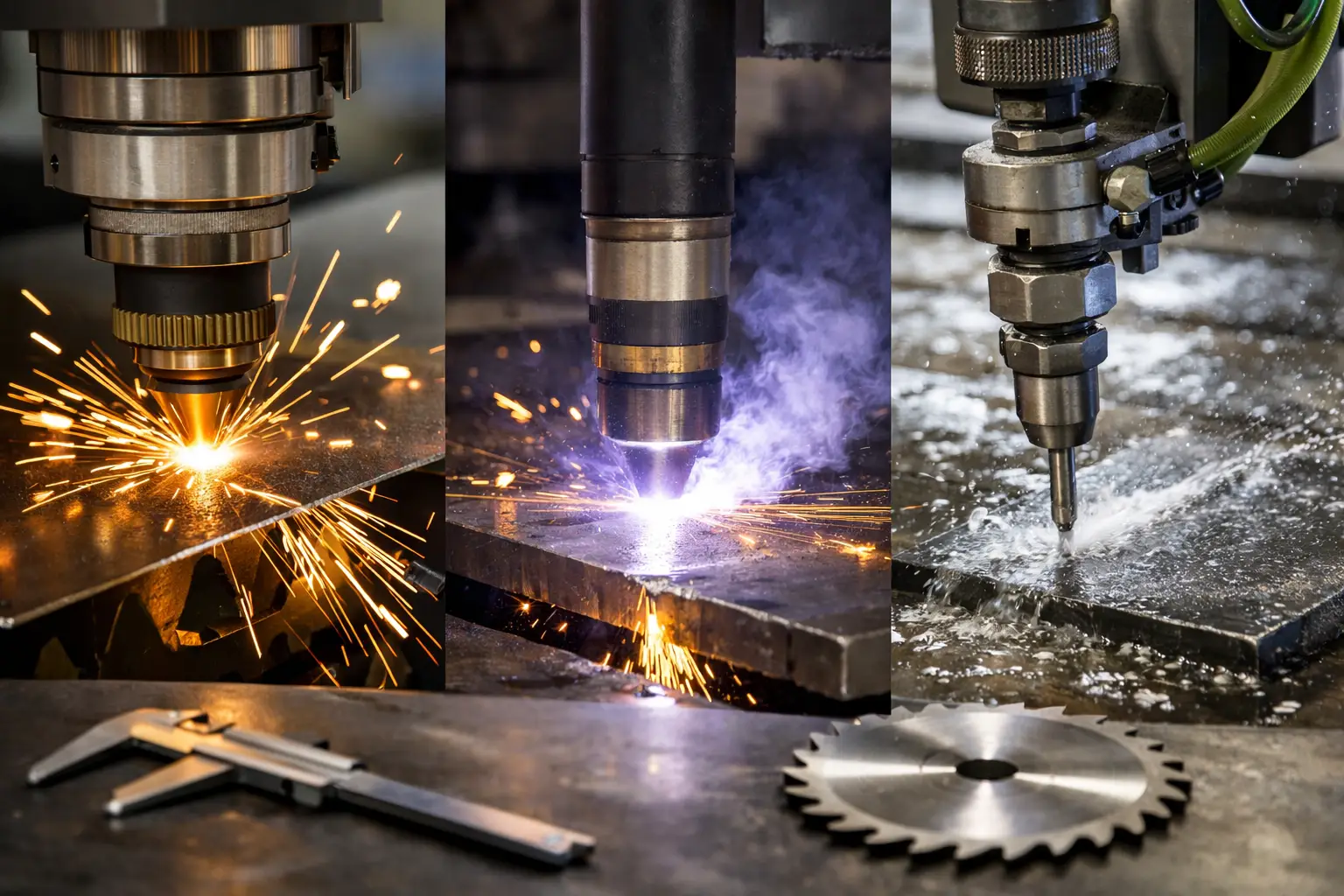
A part can be perfectly drawn and still fail on the workshop floor if the cutting method is wrong. Heat marks on stainless, distortion in thin sheet, a rough edge on a visible architectural panel, or a delayed production run can all add cost after cutting. Knowing how to choose a cutting process means looking beyond the material name and matching the process to the finished part, its tolerance, its purpose and its deadline.
For most fabrication, construction, engineering and design work, the decision comes down to laser cutting, waterjet cutting or a combination of both across different components. Each process has clear strengths. The right choice is not always the quickest cut on paper – it is the process that delivers parts ready for the next stage with the least rework.
Start with the material and its behaviour
Material is the first filter because laser and waterjet cut in fundamentally different ways. A high-definition laser uses a focused beam to melt or vapourise material along the programmed profile. It is exceptionally efficient for many sheet-metal jobs, particularly where speed, repeatability and fine detail are required.
A CNC waterjet uses a high-pressure stream of water, often mixed with abrasive, to erode the material. At pressures up to 60,000 PSI, it creates an accurate cut without putting heat into the workpiece. This cold-cut process is the deciding factor when heat could alter the material or affect the finished appearance.
Laser cutting is often a strong fit for steel, stainless steel and aluminium sheet where the material thickness and job volume suit laser processing. It is particularly effective for brackets, panels, folded components, enclosures and repeated production parts.
Waterjet has broader material versatility. In addition to metals, it can cut tile, pavers, stone, rubber, foam, gaskets, timber and many composite materials. It is also valuable for metals that must retain their original properties right through the cut edge. If the job involves a non-metal material, a laminated product or a material that is sensitive to heat, waterjet is usually the first process to assess.
How to choose a cutting process by finished-part requirements
The part’s final use matters more than the raw sheet. Ask what must happen once cutting is complete. Will the part be welded, powder coated, polished, installed as a visible feature, machined further or placed straight into service? Those answers change the priority.
When heat distortion is unacceptable
Heat affects materials differently. Thin sheet can move during a thermal process, while certain alloys, coated products and heat-sensitive materials can show changes around the cut edge. In some jobs those effects are minor and easily managed. In others, they create fit-up problems, visual defects or extra finishing work.
Waterjet avoids a heat-affected zone because it is a cold cutting method. This can make it the better option for intricate stainless steel work, thicker material, pre-finished surfaces, tiles and components where dimensional stability is critical. It also avoids the hardened or altered edge that may need consideration before later machining or forming.
That does not mean laser is unsuitable for precision work. A properly selected laser process produces clean, accurate profiles at excellent speed. The practical question is whether the material and design can tolerate thermal cutting, not whether one process is universally more precise than the other.
When edge quality drives the decision
A cut edge is not simply a cut edge. Its quality affects welding preparation, paint adhesion, handling safety, assembly and how much labour is required before delivery. Laser cutting can provide a fine edge on suitable metal sheet, often making it a productive choice for fabricated parts that move quickly into the next operation.
Waterjet cutting produces an edge free from heat tint and thermal distortion. On decorative stainless, aluminium, architectural features and parts with a visible exposed edge, that can reduce finishing requirements. Waterjet edge quality is influenced by material, thickness, cut speed and the quality setting selected. A faster cut may be appropriate for functional parts, while a finer finish may be worth the extra cutting time for a presentation surface or close-fitting component.
Be clear about where the edge will be seen and what it must do. A concealed mounting plate and a decorative screen may share a material type, but they do not need the same cut specification.
When detail, corners and tolerances matter
Both CNC laser and CNC waterjet are capable of intricate profiles when the drawing is prepared properly. Small internal features, sharp corners, narrow webs and detailed patterns still need to be assessed against material thickness and the width of the cutting stream or beam. A feature that looks fine in CAD may not be practical to cut, or may be too delicate to survive handling.
Provide the actual file wherever possible, along with critical dimensions, tolerance requirements and the intended orientation of the part. Identify holes that need to mate with other components, edges that will be folded and surfaces that will remain visible. This allows the cutting method, lead-ins and cutting quality to be chosen for the job rather than applied as a generic setting.
Balance turnaround against the real cost of the job
Fast cutting matters, especially when a fabrication schedule is waiting on parts. Laser is often the efficient option for repeat metal profiles and production quantities. Its speed can make a meaningful difference where there are many identical components or a large number of simple-to-moderate profiles in sheet metal.
However, the fastest machine time is not necessarily the lowest total cost. If laser cutting produces heat effects that require additional grinding, straightening, cleaning or rejection of sensitive parts, waterjet may be the more economical route overall. The same applies when using waterjet prevents material damage on expensive plate, tile or specialised products.
Quantity also changes the decision. For a one-off prototype, the priority may be material compatibility and the ability to cut a complex shape accurately. For a recurring production run, cycle time, nesting efficiency and consistency from batch to batch become more influential. A capable cutting provider will discuss both the immediate quote and the downstream work that follows.
Consider thickness, not just the material grade
Thickness affects cut speed, edge appearance and process suitability. It is not enough to say a part is stainless steel or aluminium. The exact grade, temper where relevant, thickness and sheet condition all matter.
Laser cutting can be highly productive within suitable thickness ranges, but its performance changes as material gets thicker. Waterjet remains a practical option across a wide range of thicknesses and is often selected where thicker metal, mixed materials or heat-free cutting is required. For difficult jobs, a sample cut or a discussion around the required edge finish can prevent assumptions from becoming costly errors.
Also consider sheet condition. Protective film, galvanised coatings, painted surfaces and surface finishes may influence the preferred process and handling method. Mention these details before quoting, particularly if the finished face must remain clean and free of marking.
Give your cutting provider the right job information
Good input produces better parts. A clear request should include the material, thickness, quantity, drawing file, required delivery date and any critical tolerances. It should also state whether supplied material is being used, whether burr removal or finishing is expected, and what the component will do after cutting.
For example, a mining repair part may prioritise durability, accurate hole locations and rapid replacement. An architectural panel may prioritise fine detail, a clean visible edge and consistent pattern spacing. A gasket may require waterjet cutting to preserve the material and achieve the correct profile without heat. These are different jobs, even if each begins with a digital drawing.
At Waterjet & Laser SA, having both laser and waterjet cutting onsite allows the process to be selected around the part rather than forcing every job through one machine. That gives Adelaide fabricators, builders, manufacturers and designers a practical choice when speed, material integrity and finish all need to be considered.
Choose for the next operation, not only the first cut
The best cutting process is the one that supports the whole job. Consider the material’s response to heat, the required edge quality, design detail, thickness, quantity and what happens after the part leaves the cutting table. A short conversation before production can protect accuracy, reduce waste and keep the project moving when it matters most.