
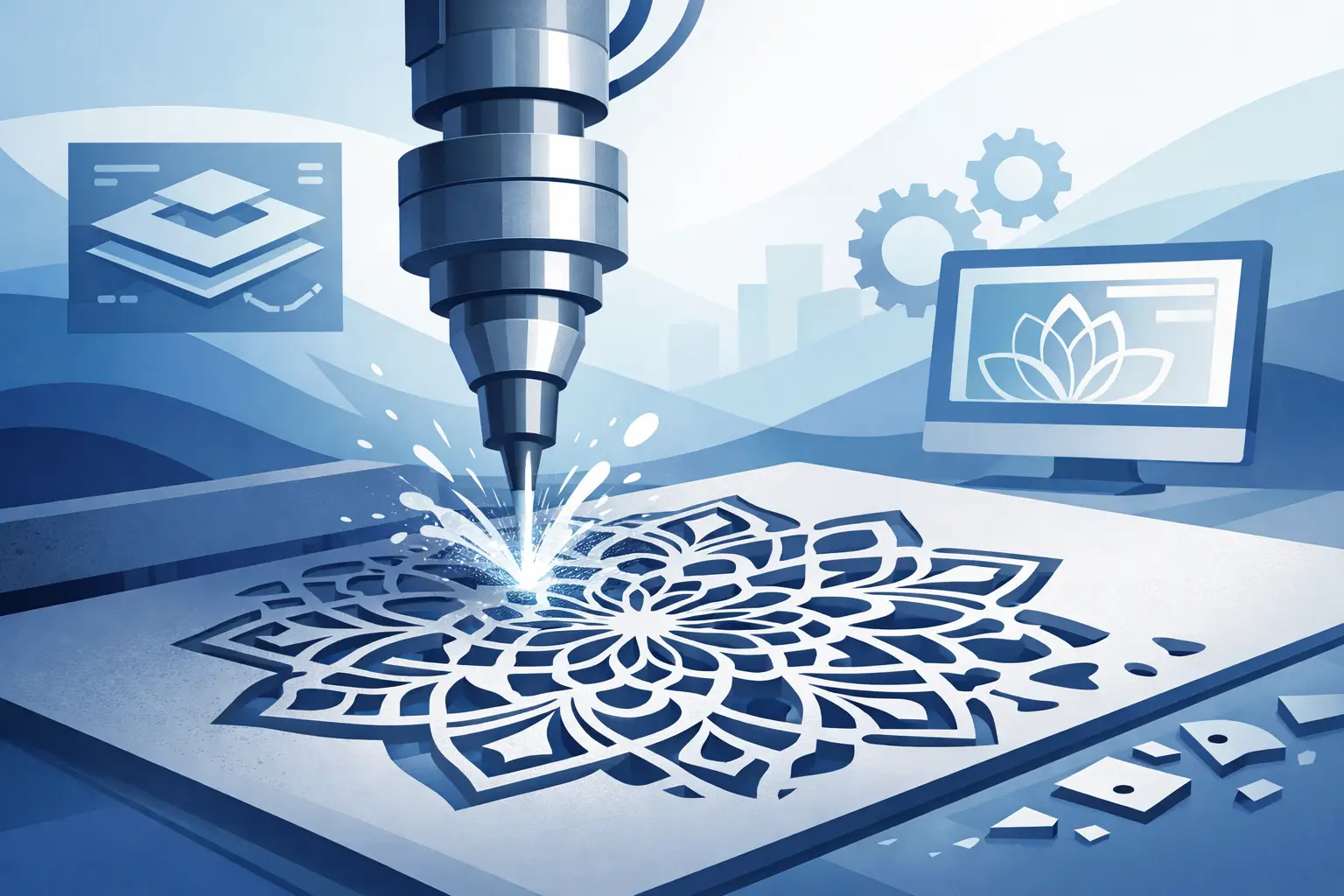
A tight internal radius, a decorative perforation pattern or a detailed mechanical profile can look straightforward on screen and become expensive very quickly if the cutting process is wrong. Waterjet cutting intricate designs gives Adelaide fabricators, builders and designers a practical way to produce fine detail in metal and other materials without exposing the workpiece to heat.
The process uses a high-pressure stream of water, combined with abrasive garnet for hard materials, to cut directly from a digital drawing. With pressure up to 60,000 PSI, the stream removes material precisely while keeping the surrounding area cold. The result is a clean, accurate cut with no heat-affected zone, no warping from cutting heat and no hardened edge that creates extra work later.
For projects where the design matters as much as the dimension, that difference is significant.
Why waterjet cutting suits intricate designs
Intricate work is not only about small features. It is about producing those features consistently across every part, whether the job is one custom architectural panel or a production run of components that must fit first time.
Because waterjet is a cold-cut process, it preserves the properties of materials that can be affected by thermal cutting. Stainless steel retains its finish around the cut, aluminium is less prone to distortion, and painted, laminated or heat-sensitive materials can often be processed with less risk of damage. This is particularly useful when a part will be folded, welded, polished, powder coated or assembled after cutting.
Waterjet also handles a broad range of materials. Steel, stainless steel, aluminium, brass, copper, stone, tile, rubber, foam and plastics can all be suitable, depending on thickness and the required finish. That flexibility is valuable for mixed-material projects, prototypes and custom fabrication where one supplier can help keep the cutting stage organised.
Fine detail does have practical limits. Very narrow slots, extremely sharp internal corners and closely spaced features need to be assessed against the material thickness and the width of the cutting stream. A good result comes from matching the design to the process, not forcing a drawing through a machine at any cost.
Design details that affect the finished part
The best time to protect quality, budget and lead time is before cutting begins. A clean production-ready file removes uncertainty and allows the cutter to focus on accuracy rather than repairing geometry.
Start with a clear CAD file
A DXF or DWG file with closed, correctly scaled vectors is generally the most useful starting point. Each cut line should be intentional. Duplicate lines, open paths and overlapping geometry can cause unnecessary machine movement or create uncertainty about which features are required.
If the design began as a hand sketch, PDF or image, it can still be a useful reference. However, complex shapes often need to be redrawn or checked before production. Dimensions, material type, thickness, quantity and any critical tolerances should accompany the file. A marked-up PDF is helpful where there are features that need particular attention.
Allow for kerf and small features
The waterjet stream has a physical width, known as kerf. Modern CNC control compensates for this when cutting to a programmed profile, but it remains relevant when a design includes very small holes, narrow webs or detailed lettering.
As a working principle, the smallest feature should be considered in relation to the material thickness. A fine pattern that works well in 3 mm aluminium may not be practical in 20 mm stainless steel. The material can also influence the quality of a small internal corner or the consistency of a narrow bridge between cut-outs.
Where possible, use radiused internal corners rather than demanding perfectly square corners. A small radius often improves cut quality, reduces cutting time and better reflects how real components perform under load. For decorative work, thoughtful spacing between pattern elements helps retain strength while keeping the visual effect crisp.
Consider the part after it is cut
A precision cut part still needs to be handled, fabricated and installed. Think through which face is most visible, where tabs or supports can be placed if required, and whether the part needs an edge suitable for welding, polishing or coating.
For a screen, balustrade insert or signage element, the visual face and edge finish may be the priority. For a machine bracket, hole position, profile accuracy and repeatability may matter more. Both are achievable, but the cutting strategy should reflect the job rather than treating every part the same.
Choosing waterjet or laser for detailed work
Waterjet is not automatically the best process for every intricate design. Laser cutting is often faster and highly economical for thinner sheet metal, particularly when the design has many repeated parts and the material is well suited to thermal cutting.
Waterjet earns its place when heat distortion, heat-affected edges or material sensitivity are concerns. It is also a strong option for thicker materials, reflective metals, mixed materials and shapes that would be difficult to laser cut without changing the material’s characteristics. For example, a detailed aluminium component that must stay flat, or a stainless part requiring a clean edge for later finishing, may be better suited to waterjet.
The right choice depends on material, thickness, edge requirements, tolerance, quantity and deadline. Having both CNC waterjet and laser cutting available onsite means Waterjet & Laser SA can recommend the process that fits the part, rather than asking the part to fit a single machine.
Accuracy is more than a machine setting
A high-pressure waterjet is capable of exceptional accuracy, but finished-part quality relies on several connected decisions. Material condition, nesting, nozzle condition, cutting speed and the programmed path all influence the result.
Cut too quickly and an edge may show more taper or a rougher finish. Cut more slowly and the edge quality can improve, but the job takes longer. On a visible architectural piece, the extra time may be worthwhile. On concealed structural components, a standard production finish may be the sensible balance between quality and cost.
Material movement also matters. Large sheets, thin sections and parts with extensive internal cut-outs can release stress as they are cut. Careful fixturing and cutting sequence reduce the chance of movement affecting critical dimensions. This is one reason experienced operators remain important, even with accurate CNC equipment.
Practical applications across Adelaide projects
Intricate waterjet work appears in more places than many people expect. Fabricators use it for brackets, gussets, flanges, machinery guards and custom plates. Builders and architectural suppliers use detailed cut panels, feature elements, privacy screens and signage components. Designers use it for decorative patterns, furniture parts and one-off prototypes.
It is equally useful when a replacement component is no longer readily available. A worn or damaged part can often be measured, drawn and cut from the appropriate material, saving downtime and avoiding a complete redesign. For production work, a proven file can be retained for repeat orders, helping maintain consistency as requirements change.
Local cutting support is especially useful when the schedule is tight. Clear communication around the file, material and required date helps avoid the delays that come from assumptions. It also makes it easier to arrange delivery across metropolitan Adelaide and country South Australia when the parts are ready.
How to get a better result from your next job
Bring the cutting provider into the conversation early, particularly when the design includes fine detail or unusual materials. A short discussion before finalising the drawing can identify features that are likely to slow the job, weaken the part or add avoidable cost.
Provide the intended use of the component, not only its dimensions. Knowing whether a panel is decorative, load-bearing, welded, folded or exposed to weather gives useful context for material and finish recommendations. If visual consistency is critical, say so. If turnaround is the priority, that should be stated as well.
Most importantly, retain room for practical adjustment. A small change to slot width, corner radius or pattern spacing can make a detailed design easier to cut and stronger in service without changing its purpose or appearance. That is where precision cutting becomes more than a machine process – it becomes a reliable part of the finished project.
When the drawing is ready, send the file with the material, thickness, quantity and required date. A clear brief gives the cutting team the information needed to turn an intricate idea into parts that arrive ready for the next stage of work.