
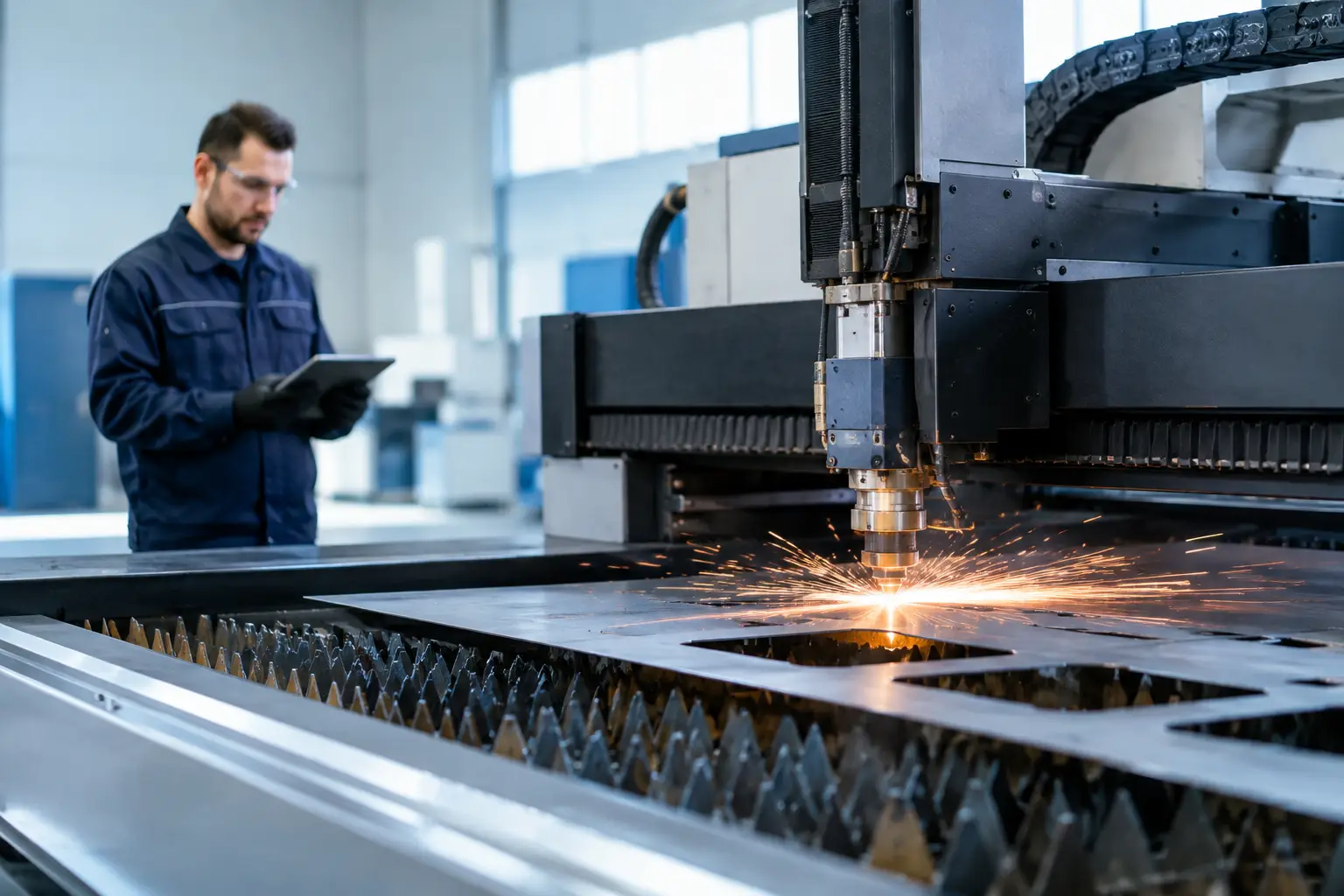
A fabrication job can be ready to assemble except for one missing bracket, plate or gasket. When the cutting queue is full, a machine is down, or a drawing calls for work your equipment cannot handle cleanly, outsourced cutting capacity keeps the schedule from slipping. It gives businesses access to accurate profile cutting without the capital cost, maintenance burden or staffing pressure of adding another machine to the workshop.
For fabricators, builders, manufacturers and project managers, the value is not simply having someone else cut material. It is having the right parts arrive to drawing, with an edge quality and turnaround time that suit the job. That requires a cutting partner that understands material behaviour, nesting, tolerances and the difference between a quick part and a usable part.
When outsourced cutting capacity makes commercial sense
Buying CNC cutting equipment can be the right move for high, predictable volumes. But it is a major operational commitment. The purchase price is only the start. There is programming, consumables, servicing, extraction or abrasive handling, operator training, floor space and downtime to manage. A machine that sits idle between projects is expensive capacity.
Outsourcing is often the more practical option when demand changes from week to week, a contract has created a temporary spike in workload, or a business needs to quote work outside its usual material range. It also protects production when an in-house cutter is booked out or unavailable. Rather than turning down profitable work or pushing delivery dates, you can add cutting capacity as needed.
This approach is particularly useful for project-based work. A builder may need accurately cut aluminium components for one fit-out and rubber isolation pads for the next. An engineering workshop might require stainless steel machine guards in a short run, followed by thicker steel base plates. Maintaining every cutting capability in-house rarely makes sense at that level of variation.
Outsourced work is not automatically cheaper in every case. If a part is simple, repetitive and produced in very high numbers, internal cutting may deliver a lower unit cost. The decision should account for the full cost of ownership, not only the hourly machine rate. Include labour, programming time, material handling, rejects, maintenance and the cost of a delayed job.
Choose the cutting process, not just a supplier
The strongest outsourced cutting capacity comes from a provider with more than one process available. Waterjet and laser cutting solve different problems. Selecting the suitable method early can improve lead times, reduce secondary finishing and avoid material damage.
Where laser cutting is the efficient choice
High definition laser cutting is generally well suited to many metal profiles where speed and fine detail are priorities. It is effective for steel, stainless steel and aluminium components, particularly where sheet parts need to be produced efficiently and consistently. For fabricators producing brackets, panels, tabs, covers and architectural elements, laser cutting can provide clean, repeatable profiles ready for the next stage.
Laser is not the best answer for every material or thickness. As a thermal process, it creates a heat-affected zone. That may be acceptable, or it may matter greatly depending on the material, finish, tolerance and subsequent fabrication steps. Thin decorative metalwork and production components may suit laser perfectly, while heat-sensitive material or thicker specialised work may call for another method.
Where waterjet cutting earns its place
CNC waterjet cutting uses a high-pressure stream, up to 60,000 PSI, to cut material without introducing heat distortion. The cold-cut process preserves the properties of the material around the cut, which is valuable where warping, hardening or a heat-affected edge would create problems.
Waterjet is highly versatile. It can profile steel, stainless steel, aluminium, tile, pavers, timber, rubber, foam, gasket materials and many other materials that are unsuitable for laser cutting. It also handles intricate shapes, internal cut-outs and thicker sections with accuracy.
That versatility can simplify purchasing and production. Instead of using separate suppliers for a metal plate, a rubber gasket and a custom tile feature, a project team can coordinate compatible work through one cutting specialist. The process may not always be the fastest option for every thin metal part, but it can prevent costly compromises in material integrity and edge quality.
Give your cutting partner the information that prevents rework
Fast turnaround begins before the material reaches the cutting bed. Clear job information allows the cutting team to assess the drawing, select the process and plan the work properly. A clean DXF file is generally ideal for profile cutting, although PDF drawings, sketches and sample parts can help establish requirements for more bespoke work.
Dimensions alone are not always enough. Specify the material grade, thickness, quantity, finish requirements and any critical tolerances. Identify features that must align with existing assemblies, such as bolt holes, folds, machined faces or mating parts. If the material is customer-supplied, confirm its condition, size and whether protective film or surface finish needs to be preserved.
It also helps to explain the intended use. A plate that will be welded, powder coated or used as a visible architectural feature can have different priorities. For welded parts, a fabricator may value fit-up and consistent kerf. For a decorative screen, edge appearance and fine detail may take priority. For a gasket, material accuracy and clean, undistorted cutting are usually critical.
A capable supplier will ask questions where needed rather than simply cutting what appears on screen. That conversation is not a delay. It is how avoidable errors are found before material is consumed.
Build flexibility into your production plan
Outsourced cutting capacity works best when treated as part of your production system, rather than an emergency measure. Establishing a relationship before a rush job gives both parties a better understanding of your typical materials, file standards and delivery requirements. It also makes quoting and repeat ordering more efficient.
For recurring parts, keep approved drawings and revision control tight. A small change to a hole size or slot location can cause major fit-up issues if an old file is sent for cutting. Name files clearly, include revision numbers and ensure the drawing matches the order quantity. This is especially important when multiple people across estimating, purchasing and workshop teams are involved.
Lead time should be planned realistically. Cutting time is only one part of the job. Material availability, nesting, programming, loading, inspection, packing and freight all affect the delivery date. A local provider can be especially valuable for Adelaide and South Australian businesses when pickup, direct communication or reliable delivery helps maintain momentum on site or in the workshop.
There is also value in using outsourced capacity to improve workflow at your own premises. When profile cutting is handled externally, internal staff can focus on welding, bending, machining, assembly and installation. That can be more profitable than pulling skilled tradespeople away from higher-value work to manage a bottleneck at the cutter.
Quality is measured after the part is installed
A cut part is only useful if it performs in the next operation. Poor edge quality can add grinding time. Incorrect dimensions can stop assembly. Heat distortion can make a component difficult to form or weld. A late delivery can leave an installation crew waiting on site.
For that reason, evaluate a cutting provider on more than its quoted price. Look for accuracy, material knowledge, responsive communication, dependable lead times and the ability to recommend the right process. Ask how they manage unusual materials, intricate designs and repeat work. The lowest initial price can lose its advantage quickly if parts require rework or do not arrive when promised.
Waterjet & Laser SA combines onsite CNC waterjet and laser capability so customers can match the process to the part rather than forcing every job through one machine. That choice matters when workloads change, materials vary and the finished component needs to be right the first time.
The practical benefit of outsourced cutting capacity is room to say yes to more work with confidence. Keep your workshop focused on what it does best, send clear information early, and choose a cutting partner that treats every profile as part of a larger finished job.