
A bracket that is half a millimetre out, a plate edge that needs extensive grinding, or parts delayed while a contractor reworks them can hold up an entire fabrication job. Laser versus plasma cutting is not simply a question of which machine is better. It is a decision about material, thickness, tolerances, finish requirements and the work that must happen after cutting.
For Adelaide fabricators, builders, engineers and manufacturers, the right choice can reduce handling time, minimise waste and keep production moving. Both processes are proven, capable methods for profile cutting metal. Their strengths are different, and those differences matter on the workshop floor.
Laser versus plasma cutting: the practical difference
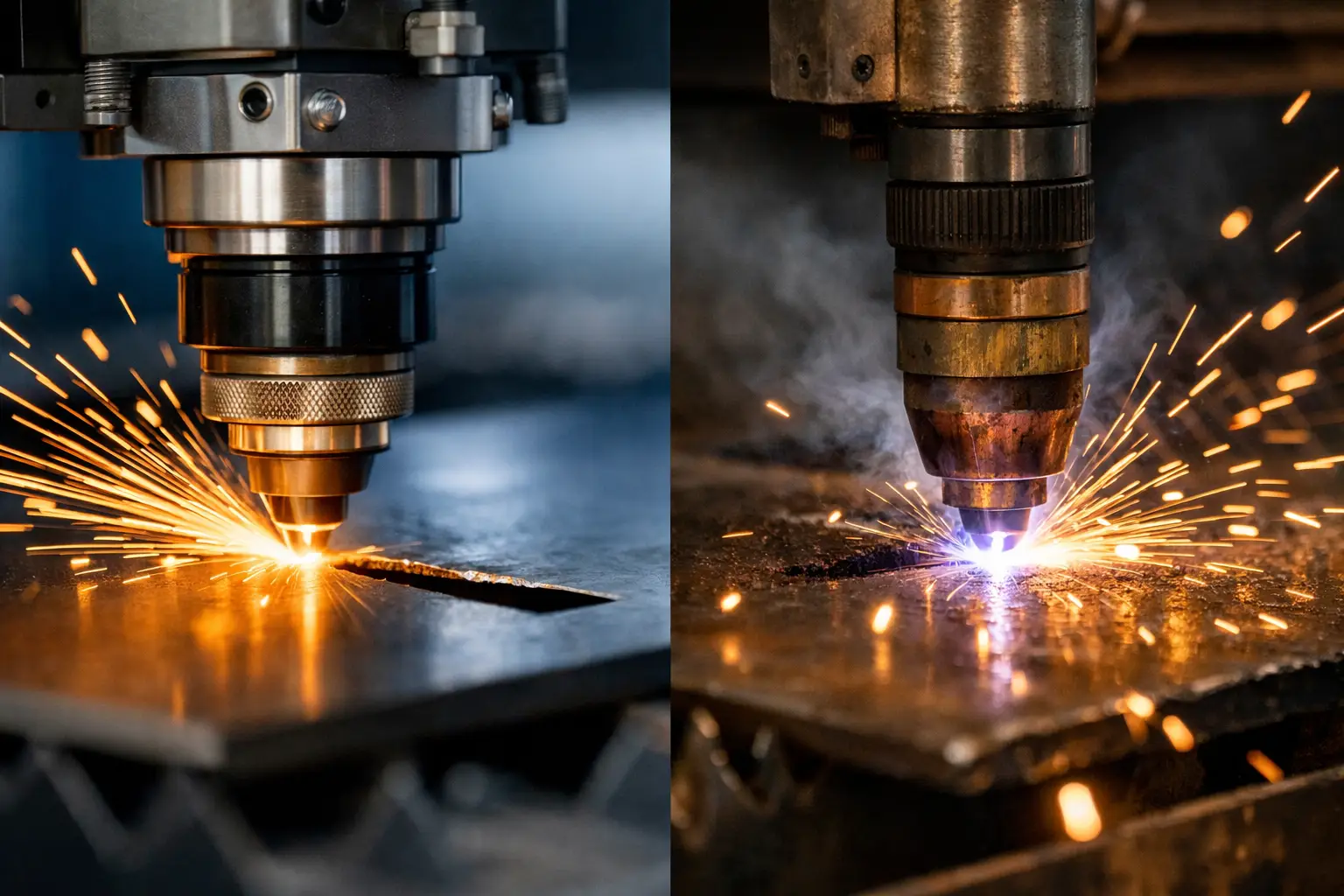
Laser cutting uses a tightly focused beam of light, generally assisted by gases such as oxygen or nitrogen, to melt or vaporise material along a programmed path. Modern fibre laser systems concentrate a very small amount of energy into a precise cutting point. The result is a narrow kerf, detailed profiles and a clean edge on suitable materials.
Plasma cutting uses an electrically conductive gas that has been heated into plasma. The plasma arc transfers energy to the workpiece and melts through the metal, while the gas stream removes molten material from the cut. It is a powerful process for conductive metals, particularly thicker carbon steel.
The distinction is straightforward. Laser is usually chosen where accuracy, fine detail and edge presentation are priorities. Plasma is often selected where thicker steel must be cut efficiently and minor finishing is acceptable. The best process depends on the specification, not the label on the machine.
Accuracy and detail: where laser earns its place
Laser cutting is the stronger option for intricate parts. Its narrow kerf and small focal point make it well suited to tight radii, small holes, tabs, slots, lettering and decorative patterns. This is valuable for architectural screens, control panels, brackets, enclosures and production components that need to fit together first time.
A laser-cut edge can also reduce downstream work. On thin to medium-gauge steel, stainless steel and aluminium, a correctly set laser often produces a clean, consistent finish that needs little more than deburring. For jobs with many repeated parts, that saving in grinding and fit-up can be more significant than the cutting price alone.
Laser does introduce heat into the material. The heat-affected zone is typically narrow, but it still exists. For most fabricated components this is manageable. Where a material is highly heat-sensitive, very thick, or must retain its original properties right to the cut edge, another process may be more suitable.
Fine features need more than a good drawing
Even the most capable laser cannot create a feature that is too small for the material thickness or the required tolerance. Hole diameter, internal corner radius, lead-in position and the condition of the source file all influence the result. Supplying a clear DXF or DWG file, with dimensions confirmed before cutting, helps prevent unnecessary revisions.
A capable cutting provider will also review whether parts can be nested efficiently. Better nesting reduces scrap and can make a meaningful difference to the cost of larger production runs.
When plasma cutting is the better commercial choice
Plasma cutting is far from a second-best process. For thicker mild steel plate, it can be an efficient and cost-effective choice, especially where parts will be welded, machined or ground after cutting. Structural plates, heavy brackets, base plates and larger industrial components are common plasma applications.
High-definition plasma has improved edge quality and dimensional control considerably compared with older conventional plasma systems. It can produce accurate, useful parts at good speed. However, the kerf is generally wider than laser, and edge bevel, dross or oxide may be more noticeable depending on thickness, settings and cut direction.
That does not make plasma unsuitable for precision work. It means the tolerance and finish requirements need to be realistic. If a part is being welded into a heavy assembly, a small amount of edge preparation may be entirely acceptable. If it is a visible stainless steel feature panel or a closely fitting mechanical component, laser is usually the more appropriate starting point.
Plasma only cuts electrically conductive materials. It is excellent for steel, stainless steel and aluminium, but it cannot cut rubber, timber, foam, tiles or composite materials. This limitation matters for projects involving mixed materials or non-metal components.
Speed, thickness and cost are linked
It is tempting to choose based on cutting speed alone, but the fastest cut is not always the fastest completed job. A plasma-cut component may leave the table quickly, yet require cleaning before welding or coating. A laser-cut component may take longer per metre on certain plate thicknesses but arrive at assembly ready for immediate use.
Material thickness changes the equation. Laser cutting is highly productive across thin and medium thickness metal, where its speed and finish are difficult to beat. As carbon steel becomes thicker, plasma can become more economical and may offer faster throughput. Exact capability varies by machine power, material grade, gas selection and the required edge quality, so there is no single thickness where every job should switch from laser to plasma.
Cost should be assessed as a total manufacturing cost. Consider material yield, cutting time, consumables, edge clean-up, machining allowances, weld preparation, coating requirements and the risk of rejected parts. A lower per-part cutting rate can be quickly lost if every part needs manual dressing.
For short runs, setup and programming also matter. A well-prepared file and clear job requirements allow a cutting team to move quickly from quote to production. For repeat orders, keeping approved drawings and specifications on file supports consistent results from batch to batch.
Heat, distortion and edge condition
Both laser and plasma are thermal cutting processes, so both can create heat-related effects. Plasma generally puts more heat into a wider area, particularly on thicker material. Thin sheet can distort if it is not programmed and supported correctly. Laser has a smaller heat-affected zone, making it a better fit for fine sheet work and detailed profiles.
The cut edge is influenced by more than the process itself. Material condition, plate flatness, gas quality, nozzle condition, power settings and cutting speed all contribute. Rust, mill scale and protective coatings can affect cut quality, particularly when a job demands a clean cosmetic finish.
If heat distortion is unacceptable, waterjet cutting deserves consideration. Waterjet is a cold-cut process that uses a high-pressure stream, up to 60,000 PSI, with abrasive added for hard materials. It can cut steel, stainless steel, aluminium, tile, stone, rubber, foam, timber and many other materials without a heat-affected zone. It is often the right answer for thick material, heat-sensitive applications, unusual materials and highly detailed work where material integrity is critical.
Choosing the right process for your job
Start with the finished part, not the cutting method. Ask what material is being cut, how thick it is, the tightest tolerance required and whether the cut edge will be visible, welded, painted or machined. Also consider whether there are fine internal details, small holes or intricate patterns that demand laser-level precision.
Laser is commonly the best fit for detailed profiles, thin to medium metal, clean edges and parts requiring minimal finishing. Plasma is a practical choice for heavier conductive plate, structural work and jobs where cutting economy and throughput take priority over a fine cosmetic edge. Waterjet becomes particularly valuable where heat must be avoided or the material falls outside the limits of thermal cutting.
At Waterjet & Laser SA, having laser and waterjet capability onsite means a job can be assessed against the required outcome rather than forced into a single process. That is particularly useful for fabrication businesses balancing tight lead times with quality requirements.
The most useful quote request includes the material grade and thickness, quantity, drawing file, critical dimensions and any finishing expectations. With those details clear from the start, the cutting process can be selected to suit the part, the budget and the deadline – leaving your team with components that are ready for the next stage of work.