
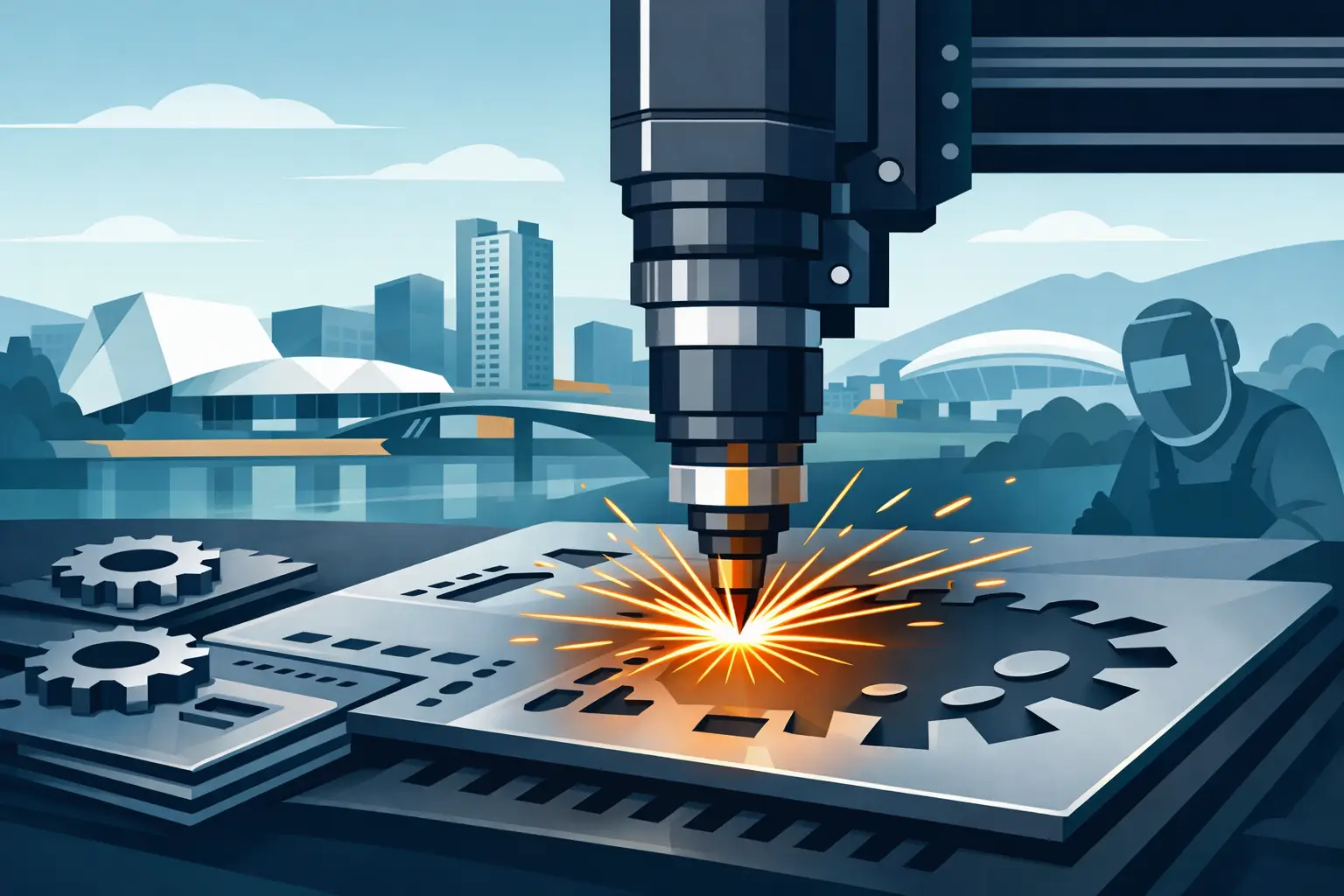
A drawing that looks straightforward on screen can become an expensive delay on the workshop floor if holes are undersized, edges need reworking or parts arrive late. Laser cutting gives Adelaide fabricators, builders and designers a fast way to turn accurate digital files into production-ready components, particularly where clean profiles, repeatability and efficient turnaround matter.
For brackets, panels, machine parts, architectural features and custom metalwork, the right cutting process reduces fitting time before welding, folding or installation begins. The key is not simply choosing a laser because it is fast. It is matching the process to the material, thickness, finish requirement and the job that follows.
Where laser cutting performs best
Laser cutting uses a focused beam to melt or vaporise material along a programmed path. An assist gas clears the cut, leaving a precise profile with a narrow kerf. Because the cut is controlled directly from a CAD file, it is particularly effective for repeat parts, detailed internal features and profiles that would take far longer to mark out and cut manually.
For many fabrication jobs, speed is the first advantage. A CNC laser can process sheet-metal components efficiently, especially in thin to medium-gauge steel, stainless steel and aluminium. This makes it a practical option for one-off prototypes as well as larger production batches, provided the file and material specification are clear from the outset.
Accuracy is equally valuable. When a set of tabs, slots, bolt holes and outside profiles is cut consistently, assembly becomes more predictable. Fabricators spend less time opening holes, grinding edges into shape or correcting pieces that do not line up. That can protect margins on a job where labour, rather than raw material, is the real cost pressure.
Laser cutting also offers considerable design freedom. Decorative screens, signage elements, balustrade infills, equipment guards and detailed feature panels can include fine linework and repeated patterns that would be difficult to achieve by conventional cutting. A good result still depends on sensible design decisions. Very narrow bridges, extremely small holes and tightly packed details need to suit the material thickness and the final application.
Laser cutting is fast, but heat matters
A laser is a thermal cutting process. That is its strength for efficient metal cutting, but it is also the reason process selection deserves proper attention. Heat is concentrated in a small area, yet it can create a heat-affected zone at the edge of the part. On many steel, stainless steel and aluminium jobs, this is entirely acceptable and the parts can move straight into fabrication.
Where edge condition is highly critical, however, the material and downstream process need to be considered. A component that will be welded, polished, coated, machined or used in a high-tolerance assembly may have different requirements from a standard bracket or enclosure panel. Some parts will need a light clean-up; others will benefit from an alternative cutting method.
Thickness also changes the equation. Laser cutting remains highly capable across a useful range of metal thicknesses, but cutting speed, edge finish and cost vary as material gets heavier. The best choice is rarely based on thickness alone. Grade, sheet condition, required tolerance, part geometry and quantity all influence the outcome.
This is where having both laser and waterjet capability onsite is valuable. Waterjet cutting uses a high-pressure stream, up to 60,000 PSI, to cut without introducing heat into the workpiece. It is often the better option for heat-sensitive materials, thicker sections, certain non-metals or jobs where preserving the material’s original properties is essential. Laser and waterjet are not competing answers to every job. They are complementary processes, and selecting the right one can save time and rework.
Choosing between laser and waterjet cutting
For straightforward metal sheet parts where speed is a priority, laser is frequently the practical choice. It suits fabricated components that need accurate profiles and repeatable holes, particularly when a project has multiple identical parts or a tight programme.
Waterjet is often preferred when the material must remain cold throughout cutting. That includes jobs involving foam, rubber, stone, composites and materials that may distort, discolour or harden under heat. It is also well suited to thicker material and complex profiles where a heat-affected edge would create problems later.
The question is not which process is universally better. It is whether the part needs laser speed, a cold-cut edge, particular material compatibility or a specific finish. A reliable cutting supplier should ask about the full job rather than simply accepting a file and pressing start.
For example, an aluminium cover panel with accurately positioned cut-outs may be ideal for laser cutting. A stainless component that requires a cold edge before precision finishing may call for waterjet. An architectural screen may be laser cut efficiently, while a mixed-material design may need a different approach. The material tells part of the story. The final use tells the rest.
Prepare the file before material is cut
The fastest way to receive accurate parts is to provide a clean, final drawing. DXF and DWG files are commonly used for profile cutting because they allow the cutting path to be read directly. PDF drawings are useful for confirming dimensions, quantities, material and revision details, but a vector CAD file gives the clearest starting point for CNC programming.
Before sending a job for quotation, check that the drawing is drawn at full scale and that all dimensions are in millimetres. Make sure duplicate lines, open contours and unnecessary construction geometry have been removed. These small issues can create uncertainty in programming or produce a result that does not match what was intended.
It also helps to specify the material completely. “Stainless” is not enough if the project depends on a particular grade, finish or thickness. The same applies to aluminium and mild steel. Include the quantity required, whether material is supplied or needs to be sourced, and the deadline that matters to the job rather than a vague request for urgency.
For assemblies, think about fit-up before the cutting stage. Slots, tabs and hole sizes should account for coating thickness, bending, welding and the tolerances of mating parts. A nominally perfect drawing can still create a difficult assembly if it ignores powder coating build-up or the way heat from welding changes a component.
A useful pre-cut check covers four points:
- final material type, grade and thickness
- accurate CAD profile at 1:1 scale
- quantity, revision number and critical dimensions
- required edge finish, secondary work and delivery date
This information allows the cutting method, nesting and production schedule to be planned properly. It also makes quotes more accurate from the start.
Design details that affect cut quality
Fine features should be designed with the material in mind. A small hole in thick plate is not the same proposition as the same hole in thin sheet. As a general principle, holes, slots and narrow gaps become harder to cut cleanly as their width approaches the material thickness. If a feature is critical, flag it early so the cutting approach can be assessed before the material is committed.
Internal corners deserve attention too. A laser beam has a kerf, so an inside corner will naturally have a small radius rather than being perfectly square. Parts that need to slot tightly together may require reliefs or dog-bone details in the drawing. These details are quick to include in CAD and can prevent a frustrating amount of hand fitting later.
Nesting is another practical consideration. Efficiently arranging parts on a sheet reduces offcut and helps control material cost. It should not, however, compromise part identification, grain direction where relevant, or the amount of clearance needed for safe cutting. On high-value material, thoughtful nesting can make a meaningful difference to the overall project cost.
Local cutting support keeps projects moving
Outsourcing cutting is not just about gaining access to machinery. It is about having dependable capacity when your own workshop is busy, a job needs parts quickly or a complex profile is beyond what can be cut efficiently in-house. Local service also makes it easier to discuss a drawing, confirm material choices and organise delivery across metropolitan Adelaide or country South Australia.
Waterjet & Laser SA combines onsite CNC laser and waterjet cutting so customers can choose the process that suits the actual job. That flexibility is useful for fabricators managing mixed materials, builders working to installation dates and designers who need detailed work cut accurately without compromising the original concept.
The best time to raise a question about a tight tolerance, unusual material or difficult feature is before the first sheet is loaded. A short conversation at the drawing stage can turn a cutting order into parts that fit, finish cleanly and keep the next stage of the job moving.