
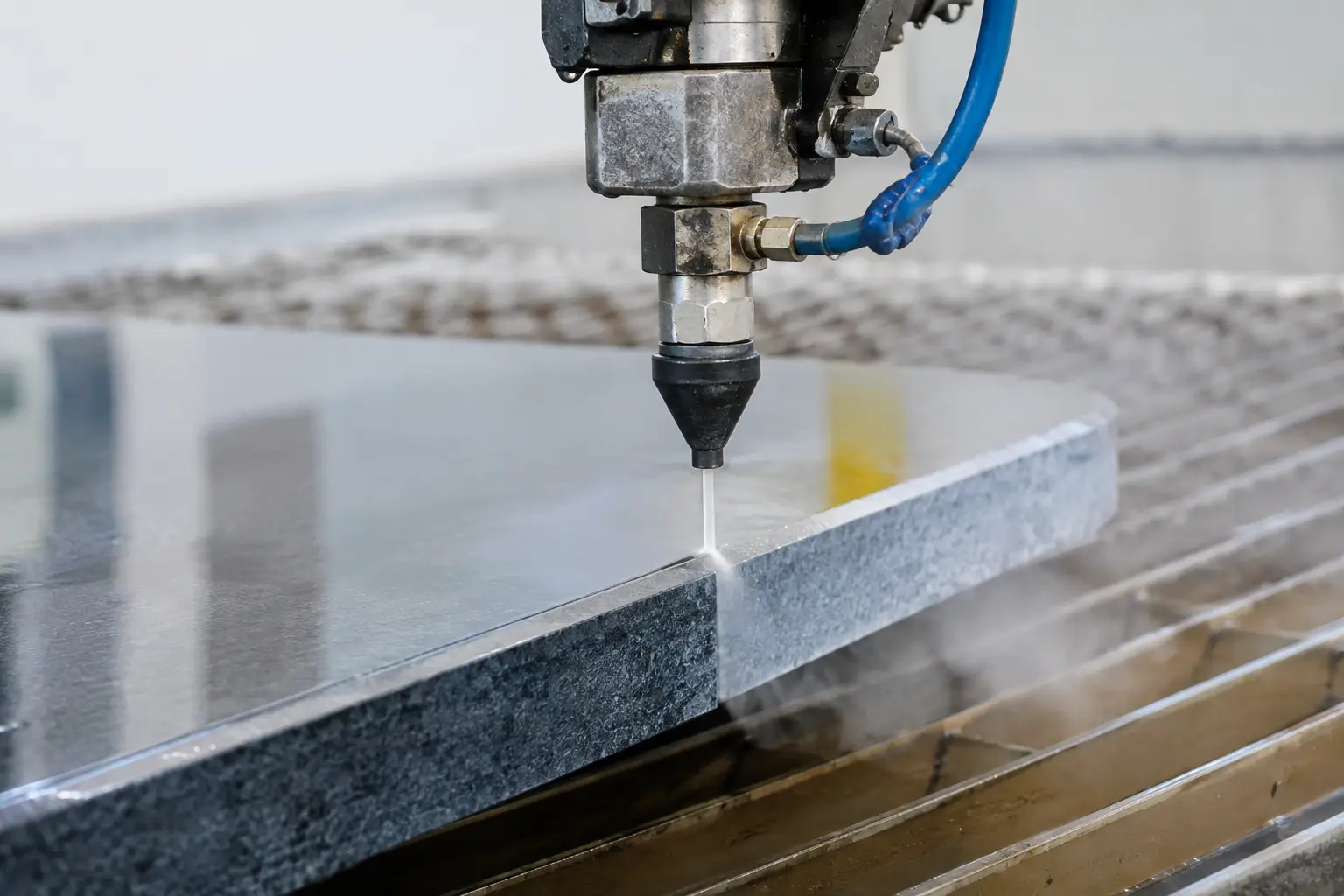
A bracket that fits perfectly but needs hours of grinding is not a precision component. Nor is an intricate stainless steel panel much use if the cut edge distracts from the finished face. This guide to waterjet edge finish explains what the cut surface tells you, what level of finish to request, and where the practical trade-offs sit between cut quality, lead time and cost.
Waterjet cutting is valued because it is a cold-cut process. A high-pressure stream of water, typically mixed with abrasive for hard materials, profiles the part without creating a heat-affected zone. That protects material properties and avoids heat distortion, but the edge finish still depends on how the job is programmed and cut.
What a waterjet edge finish actually looks like
A waterjet edge is rarely identical from top to bottom. The jet enters the material with the most energy, creating a cleaner, more consistent edge at the top. As it travels through the material, it naturally loses energy and can create visible lines, often called striations, towards the bottom of the cut.
Fine striations do not automatically mean poor work. On many fabrication, mining, construction and gasket applications, they are entirely acceptable because the cut edge will be welded, concealed, machined or used as supplied. The required finish is determined by the part’s function, not simply by whether the edge looks polished.
For a decorative screen, exposed architectural detail or precision-fit assembly, a smoother edge may be worth specifying. For thick plate that is heading into fabrication, a faster production cut can be the more commercially sensible choice. The key is agreeing on the finish requirement before cutting begins, rather than finding out after delivery that secondary finishing has become necessary.
Guide to waterjet edge finish grades
Waterjet edge quality is commonly discussed in broad grades, from a fast rough cut through to a very fine finish cut. Individual machines and suppliers may use different labels, so clear plain-language requirements are often more useful than quoting a grade alone.
A rough or separation cut prioritises speed. It is suitable where a profile is being cut oversized for later machining, where the edge is not visible, or where throughput matters more than surface appearance. More pronounced striations and slight taper may be present, particularly in thicker material.
A standard production finish gives a clean, accurate edge for a wide range of fabricated parts. This is often the practical starting point for steel, stainless steel, aluminium, rubber, gasket material and general engineering components. It provides a good balance between cut quality and cost.
A fine finish uses a slower traverse speed and more controlled cutting parameters to reduce striations and improve edge appearance. It is commonly selected for exposed stainless steel, architectural metalwork, decorative features, tight-fitting components and parts where secondary deburring needs to be minimised.
An ultra-fine finish may be appropriate when the waterjet edge will remain highly visible or when a component needs the best possible cut surface directly from the machine. It takes longer, so it should be reserved for surfaces where the improvement delivers genuine value. Waterjet produces an exceptionally clean edge, but it is not a substitute for grinding or polishing where a mirror finish is required.
The factors that change cut-edge quality
The most direct control is cutting speed. A faster jet moves through the material sooner, which lowers machine time but leaves deeper striations near the exit edge. Slowing the cut gives the jet more time to remove material cleanly and generally produces a smoother surface.
Material type also matters. Mild steel, stainless steel and aluminium each respond differently, while rubber, foam and gasket materials can have their own considerations around support and cut geometry. Brittle materials such as tile and stone require careful handling to reduce the chance of chipping. Timber and laminated products can vary with grain, glue lines and internal voids.
Thickness has a major influence. Thin sheet is generally easier to cut with a clean edge than thick plate. As thickness increases, the jet has further to travel, and the opportunity for striations or a small amount of taper increases. This does not make waterjet unsuitable for thick material. It simply means the chosen finish, tolerance and production speed need to be realistic for the application.
Abrasive condition, nozzle condition, water pressure, stand-off distance and the quality of machine programming all contribute as well. A high-pressure system operating at up to 60,000 PSI gives the cutting process the energy needed for demanding profiles, but equipment capability only delivers results when the part is correctly nested, supported and programmed.
Taper, corners and small details
Taper is the slight difference between the entry and exit side of a cut. On a basic fast cut, the lower edge can be marginally narrower or wider than the upper edge depending on the direction of jet lag and toolpath movement. Modern CNC waterjet systems can compensate for taper on suitable work, improving wall straightness where it matters.
Corner quality deserves equal attention. When a cutting head changes direction sharply, the jet needs to slow down to maintain accuracy. If it does not, corners can round off or show a witness mark. Good programming anticipates this behaviour, particularly on internal slots, tight radii, lettering and intricate patterns.
Very small holes and narrow slots are another case where expectations should be discussed early. Waterjet is highly versatile, but the kerf – the width of material removed by the jet – sets a practical limit on the smallest feature that can be reliably produced. If a feature is critical for fastening, alignment or press-fit assembly, provide the finished dimension and its tolerance rather than relying only on a drawing scale.
How to specify the finish you need
The best request for quote does more than identify material and thickness. Explain what happens to the edge after cutting. Will it be welded, painted, powder coated, visible to customers, used as a sealing face, or machined? That information helps determine whether a standard production edge is sufficient or a fine finish is the better choice.
If the part has an important visible face, identify which side it is. The entry side of a waterjet cut is generally the cleaner side, so part orientation can make a noticeable difference to the final result. For decorative panels and architectural work, it is also useful to nominate the front face, grain direction where relevant, and whether tabs or micro-joints are acceptable.
Provide the material grade where known, actual thickness, quantities, file format and any critical dimensions. A DXF file with clean, closed vectors is ideal for many profile-cut jobs. If you only have a sketch, photo or concept, it can still be a useful starting point, but allow time for drawings to be checked before production.
Where a part will be welded or assembled, consider the total workflow. A marginally finer edge may save labour at the bench by reducing deburring and clean-up. Conversely, paying for an ultra-fine finish on a hidden weld prep edge may add cost without improving the final product. The right specification is the one that lowers the total job cost, not merely the cutting cost.
When waterjet is the better edge-finish choice
Waterjet is especially useful when heat would cause problems. Stainless steel that must retain corrosion resistance, aluminium prone to distortion, coated materials, rubber, foam and many layered materials benefit from cold cutting. There is no heat-affected zone to harden, discolour or warp the surrounding material.
For straightforward thin metal profiles, high-definition laser cutting may be faster and may offer an excellent edge at a lower per-part cost. For thicker materials, mixed material jobs, intricate internal profiles or projects where heat distortion is unacceptable, waterjet can be the stronger option. The best process depends on material, thickness, required edge quality, quantity and deadline.
At Waterjet & Laser SA, having both cutting capabilities onsite means that decision can be made around the finished part rather than forcing every job through one process. For Adelaide fabricators, builders, engineers and designers, that can reduce handling, shorten lead times and keep quality expectations clear from the start.
A well-specified waterjet edge should arrive ready for its next operation, whether that is welding, coating, assembly or installation. Share how the part will be used, nominate the faces that matter, and let the required finish guide the cutting approach. That is how a profile cut becomes a dependable finished component rather than another task waiting at the grinder.