
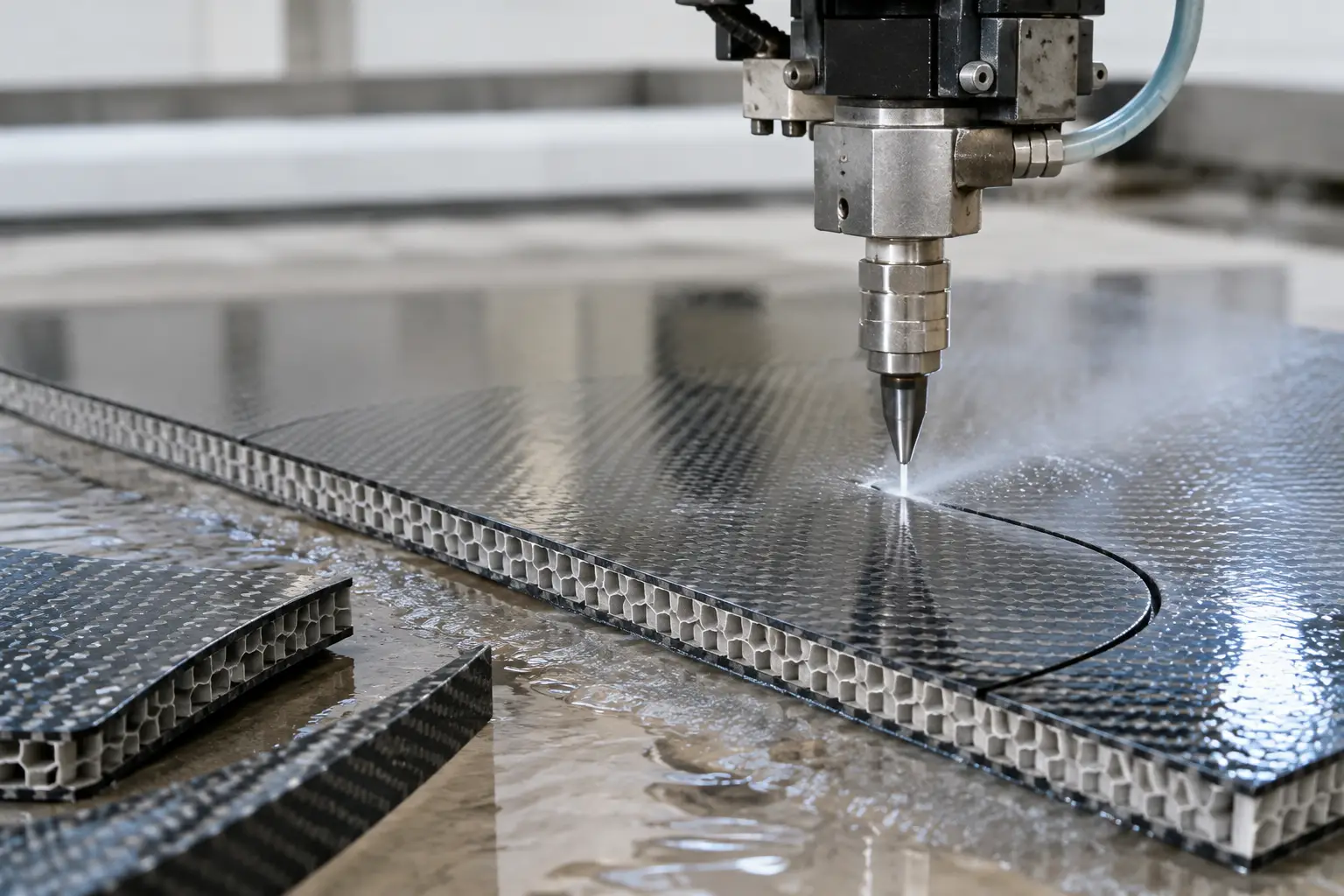
A carbon-fibre panel can look perfect right up to the moment a cutting process overheats an edge, frays a fibre or separates a laminate layer. That is why fabricators and project managers often ask: can waterjet cut composites without compromising the material? In many cases, yes. Abrasive waterjet cutting is one of the most capable processes for profiling composite materials because it cuts cold, applies no direct cutting force and handles intricate geometry with excellent accuracy.
The right result still depends on the composite construction, thickness, finish requirements and part design. A well-set-up waterjet job protects the value already built into the material rather than creating extra finishing work.
Can waterjet cut composites cleanly?
Waterjet cutting uses a highly focused stream of water, mixed with fine abrasive when required, to erode material along a programmed cutting path. At pressures of up to 60,000 PSI, the stream has the energy to cut dense and layered materials without a heat-affected zone.
This matters with composites. Many composite parts combine fibres, resins, cores and surface finishes that respond poorly to heat. Laser cutting can be suitable for some materials, but it can also char resin, discolour surfaces or alter the edge condition of heat-sensitive laminates. Conventional machining can introduce mechanical stress, vibration and tool wear. Waterjet avoids those particular issues.
For suitable composite materials, the result is a precise profile with no heat distortion and no molten or burnt edge. This makes it a strong option for prototype parts, short production runs, replacement components and detailed custom work where clean geometry matters.
Which composite materials are suitable?
Abrasive waterjet cutting can be effective across a broad range of composite sheet and panel materials. Common examples include carbon fibre reinforced polymer, glass fibre reinforced polymer, fibreglass laminates, Kevlar or aramid-reinforced materials, phenolic composites, resin-bonded panels and fibre-cement products.
It can also cut sandwich panels made with composite skins and lightweight cores, including some foam and honeycomb constructions. These panels need more careful assessment than solid laminates. A waterjet stream that is ideal for cutting through a dense carbon-fibre sheet may need adjusted settings for a thin-skinned panel with a delicate core.
Material condition matters as much as material type. A cured laminate behaves differently from a green or partially cured part. Surface coatings, protective films, embedded metal inserts and adhesive layers can also affect the chosen process. Providing a sample, technical data sheet or offcut before production is often the most reliable way to confirm edge quality and cutting parameters.
Why cold cutting is an advantage
Composite materials are engineered for performance, but their different layers do not always react to heat in the same way. Resin can soften or burn before reinforcement fibres are fully cut. This may leave darkened edges, unpleasant fumes or local damage that is difficult to remove without changing the part size.
Waterjet is a cold-cut process. It does not create a conventional heat-affected zone, so there is no thermal warping, burnt resin or heat-driven movement around the cut line. That benefit is especially useful where the finished edge will remain visible, bond to another component or sit against a close-tolerance mating part.
The process also produces very little mechanical load on the workpiece. There is no rotating cutter pushing against the laminate, which helps reduce the risk of cracking or movement during cutting. For thin sheets, narrow features and intricate internal cut-outs, this can make a substantial difference to part quality.
Precision depends on the job setup
Waterjet can produce accurate composite parts, but precision is not simply a machine setting. It comes from the full job setup: stable material support, correct nozzle selection, suitable abrasive flow, cutting speed, lead-in position and a clean, accurate CAD file.
The waterjet stream has a small kerf, allowing closely spaced details and efficient nesting of parts. Less wasted material is valuable when working with expensive carbon fibre or specialist laminates. Complex shapes, holes, slots, radii and decorative patterns can be cut directly from a drawing without the need for custom tooling.
There are practical limits. The waterjet stream is not perfectly straight through every material and thickness, so kerf taper can occur, particularly in thicker sections or when a faster cut is selected. Advanced cutting settings and suitable allowances manage this, but the required tolerance should be discussed before quoting. A cosmetic cover panel, for example, may have different edge expectations from a tightly controlled engineering component.
Managing delamination, fraying and moisture
The usual concerns with composite cutting are delamination, fibre fraying and edge finish. These risks are real, but they are not automatic outcomes of waterjet cutting. They are managed through appropriate fixturing and cutting parameters.
A stable panel prevents lift or vibration as the jet exits the material. Entry and exit points should be planned carefully, particularly around visible surfaces, sharp corners and small tabs. Cutting speed must also suit the material. Moving too quickly may reduce edge quality; moving too slowly can be unnecessary and affect production cost.
Because waterjet uses water, moisture is another consideration. Most cured composite panels tolerate the process well, but moisture-sensitive cores, uncured materials or parts with open cellular construction need assessment. The cut parts can be dried after processing where needed, yet this should not replace a proper review of the material specification.
Abrasive particles may also be a concern for certain high-cleanliness applications. When the finished part is used in specialised equipment, medical, electrical or aerospace-adjacent work, advise the cutter about cleaning requirements and whether edges need further finishing. Waterjet creates an excellent cut edge for many applications, but no process should be selected without considering the complete downstream use.
Waterjet versus laser and CNC routing
There is no single best cutting process for every composite. The correct choice comes down to the material, detail, volume, thickness and required edge condition.
Laser cutting is fast and highly effective for many sheet materials, particularly metals and suitable thin products. However, heat-sensitive composites may show burning, fume generation or resin damage. Where the composite can tolerate laser energy and production speed is the priority, laser may be worth considering. Where preserving material integrity is critical, waterjet is commonly the safer choice.
CNC routing is another established method for composites. It can be efficient for repeated work and may suit certain thicknesses or machining requirements. The trade-off is tooling contact. Cutters wear, fibres can be abrasive and tool pressure can contribute to fraying or delamination if settings are not right. Dust extraction is also a significant consideration, particularly with carbon fibre.
Waterjet eliminates cutting-tool wear and reduces airborne cutting dust at the source because the process takes place in water. It is particularly useful for detailed one-off shapes and mixed material jobs where a cold-cut process is preferred.
Information that helps achieve a better result
The strongest waterjet jobs begin before the sheet reaches the cutting bed. A clear drawing, preferably in a usable vector or CAD format, allows the cut path to be checked for small features, internal corners and material-efficient nesting. Dimensions, tolerances and any critical faces should be identified rather than assumed.
It also helps to confirm the composite type, nominal thickness, reinforcement, resin system and whether both faces are cosmetic. If there is a preferred face for the cleaner edge, say so. Details such as protective film, existing holes, inserts and grain or fibre direction can influence how the panel is supported and cut.
For production work, a first-off part or test cut is sensible where the specification is demanding. It confirms fit, edge condition and cycle time before the full quantity is processed. This is a practical safeguard on costly materials, not an unnecessary delay.
A capable option for Adelaide composite projects
For Adelaide fabricators, builders, manufacturers and designers, outsourcing composite cutting can remove the cost of specialist equipment, consumables and trial-and-error setup. Waterjet & Laser SA combines onsite CNC waterjet and laser capability, allowing the cutting method to be selected around the job rather than forcing every material through one process.
Whether the requirement is a carbon-fibre bracket, a fibreglass enclosure panel, a patterned laminate feature or accurately cut components for a larger fabrication, the key is to match the process to the performance required from the finished part. Bring the material details and the intended application into the conversation early. A few decisions before cutting can protect the panel, the programme and the finished result.