
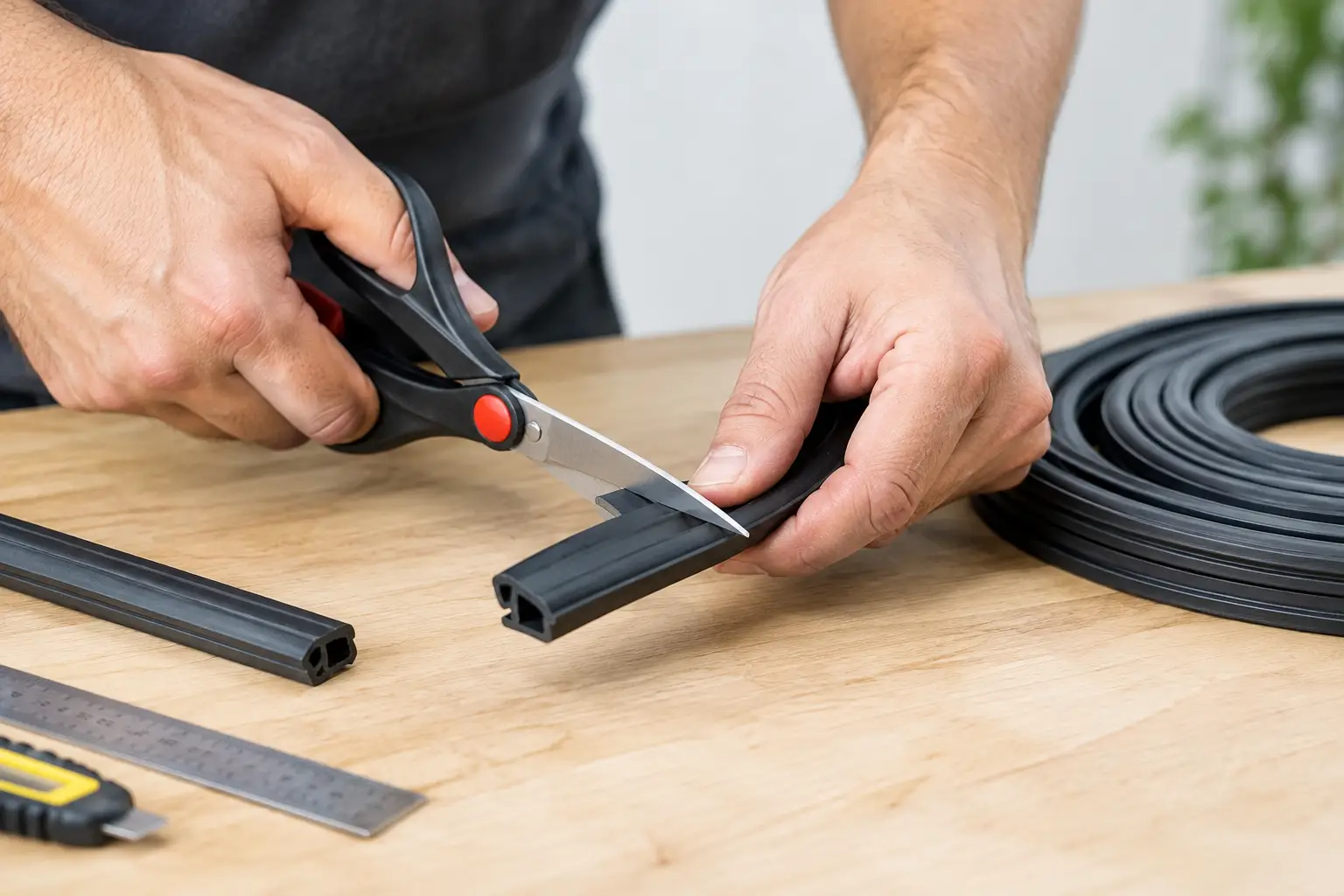
A rubber seal can be the smallest item in an assembly and still be the reason a pump leaks, a cabinet rattles or a dust barrier fails inspection. To cut rubber seals properly, the profile, material grade and cutting method must work together. A clean-looking part is not enough if the edge is hardened, the holes are out of position or the seal has stretched before it reaches site.
For fabricators, maintenance teams and manufacturers, accurate seal cutting removes a common source of rework. The goal is a part that sits flat, follows the mating faces precisely and performs as intended under compression, pressure, vibration or changing temperatures.
Start with the seal’s working conditions
Rubber is not one material. Natural rubber, neoprene, nitrile, EPDM, silicone and polyurethane all respond differently to oils, weather, heat, abrasion and compression. Selecting the right compound is the first decision. Cutting it correctly is the next.
A nitrile gasket may be chosen for fuel or oil resistance, while EPDM is often specified for outdoor weathering and water applications. Silicone can suit higher-temperature environments, and polyurethane may be selected where abrasion resistance matters. If the material is wrong for the job, perfect cutting dimensions will not save the finished assembly.
Thickness also changes the cutting approach. Thin rubber can move or lift if it is not supported. Thicker sheet needs a process that maintains a square, accurate edge through the full depth. For parts with narrow bridges, tight internal corners or closely spaced holes, profile accuracy becomes even more critical.
Before production, confirm the material type, thickness, hardness, finished quantity and the environment the seal will face. A drawing is ideal, but a physical sample, marked-up template or accurate measurements can also provide a workable starting point for a custom profile.
Why manual cutting can become expensive
For a one-off temporary patch, a sharp knife and straightedge may be adequate. For repeatable production seals, it quickly becomes a false economy. Hand-cut edges can wander, corners may tear, and internal cut-outs are difficult to position consistently. Even small variations can create leaks or uneven compression.
Die cutting is efficient for high-volume, repeated shapes once tooling exists. It is less flexible when designs change, quantities are modest or a job needs a fast replacement part. Tooling cost and lead time must be weighed against the number of parts required.
Laser cutting can be useful for certain rubber products, but heat is the key consideration. Some compounds may char, discolour, release fumes or develop a heat-affected edge. That may be acceptable for a non-critical packing piece, but it is not always suitable for sealing faces, food-related applications or parts where material integrity matters.
The best method depends on the rubber compound, profile detail, thickness, edge requirement and production quantity. There is no single cutting process that suits every seal.
Waterjet cutting rubber seals with a cold process
CNC waterjet cutting is often a strong option for cut rubber seals because it uses a cold-cut process. A high-pressure stream of water, with abrasive added when required for the material, follows the programmed profile without putting heat into the sheet. This helps preserve the characteristics of the rubber around the cut edge.
At pressures up to 60,000 PSI, waterjet technology can accurately cut detailed profiles, bolt holes, slots, radii and internal openings. It can produce one replacement gasket from a sample or repeat a programmed design across a larger batch. Because no heat distortion is introduced, the finished part remains closer to the condition of the original sheet.
This is particularly valuable where a seal has complex geometry: irregular flanges, multiple ports, narrow sections, or large custom shapes that would be awkward to cut by hand. It also allows design revisions without the expense of new dies.
Waterjet cutting does have practical limits. Very soft materials need suitable support and programming to prevent movement, and the edge finish must be matched to the application. A specialist cutter will assess the sheet, hold-down method and required tolerances before committing to a process.
Design details that affect the finished seal
A seal is often specified by its outside dimensions, but several less obvious details determine whether it fits and functions. Hole sizes and their centre positions matter just as much as the external profile. If bolt holes are even slightly misplaced, the seal can pull during installation and distort around ports or corners.
Corner geometry deserves attention too. A sharp internal corner can concentrate stress and may be difficult to reproduce exactly depending on the cutting process and nozzle diameter. Where the application allows, a small radius can improve durability and make the profile more practical to manufacture.
Tolerance should be realistic for the material and its purpose. Rubber is flexible, and a compressed gasket does not always require the same tolerance as a precision metal component. On the other hand, seals for closely aligned housings, valves or equipment covers may need tight control around critical openings. Identify the dimensions that genuinely matter rather than applying unnecessarily tight tolerances to the whole part.
Allow for the mating surface as well. A perfectly cut seal cannot compensate for warped flanges, damaged threads, poor bolt loading or rough sealing faces. If failures persist, inspect the full assembly rather than assuming the gasket alone is at fault.
Preparing a file or sample for production
A clean vector drawing in DXF format is usually the most efficient way to send a profile for CNC cutting. It should show the final dimensions, hole locations, material thickness and any critical tolerances. Closed lines and clearly defined layers help avoid ambiguity.
That said, not every maintenance job begins with a CAD file. An old gasket, a cardboard template or a carefully measured sketch can be enough to reproduce a replacement. For a worn sample, check whether the rubber has compressed, stretched or torn before treating its dimensions as final. Measuring the mating flange can provide a more reliable reference.
Include practical information with the request: the material required, number of parts, whether the rubber is customer-supplied, and the date the parts are needed. If a seal is for a shutdown, breakdown repair or site installation, say so early. It allows production and delivery expectations to be set properly.
Common faults to avoid when cutting rubber seals
Most seal issues are preventable when the material and process are considered before cutting. Watch for these four common faults:
- Heat-affected edges that harden, char or alter the rubber compound.
- Ragged edges or torn internal corners that prevent even compression.
- Incorrect hole centres that force the seal out of position during installation.
- Using a material that is incompatible with the fluid, temperature or outdoor exposure.
Another frequent issue is assuming all black rubber sheet is interchangeable. It is not. A part exposed to hydraulic oil, saltwater, UV, high heat or abrasive movement needs a compound selected for that environment. When specifications are uncertain, supply as much information as possible about the service conditions before material is ordered.
When precision cutting is the sensible option
Outsourced CNC cutting is particularly useful when a job involves recurring replacement seals, multiple identical parts, intricate patterns or materials that are difficult to process in-house. It avoids tying up workshop labour on slow hand-cutting while delivering a profile that can be repeated when the next order is needed.
For Adelaide businesses needing rubber, foam or gasket profiles, Waterjet & Laser SA can assess the material and cut method before producing the part. The benefit is not simply a faster shape from a sheet. It is a more dependable component that arrives ready for fit-up, with the accuracy needed for the application.
A well-cut rubber seal should disappear into the job. It should align without force, compress evenly and keep doing its work long after installation.