
A drawing can be dimensionally perfect and still produce a poor part if the cutting process changes the material around the cut. That is the practical answer to when is waterjet more accurate: when accuracy means more than following a profile line. If heat, distortion, material hardening or edge damage could affect fit, finish or downstream fabrication, abrasive waterjet cutting often delivers the more dependable result.
For Adelaide fabricators, builders, engineers and designers, the right choice is rarely about declaring one process universally better. Waterjet and laser cutting are both highly capable CNC processes. The best result comes from matching the method to the material, thickness, tolerance, edge requirement and production schedule.
Accuracy is more than a measurement on the drawing
A part is accurate when its finished dimensions, shape and material condition allow it to do its job. For a bracket, that may mean holes align and the component sits flat. For a gasket, it may mean the profile seals correctly without a torn edge. For an architectural panel, it may mean fine details remain crisp and the sheet stays flat after cutting.
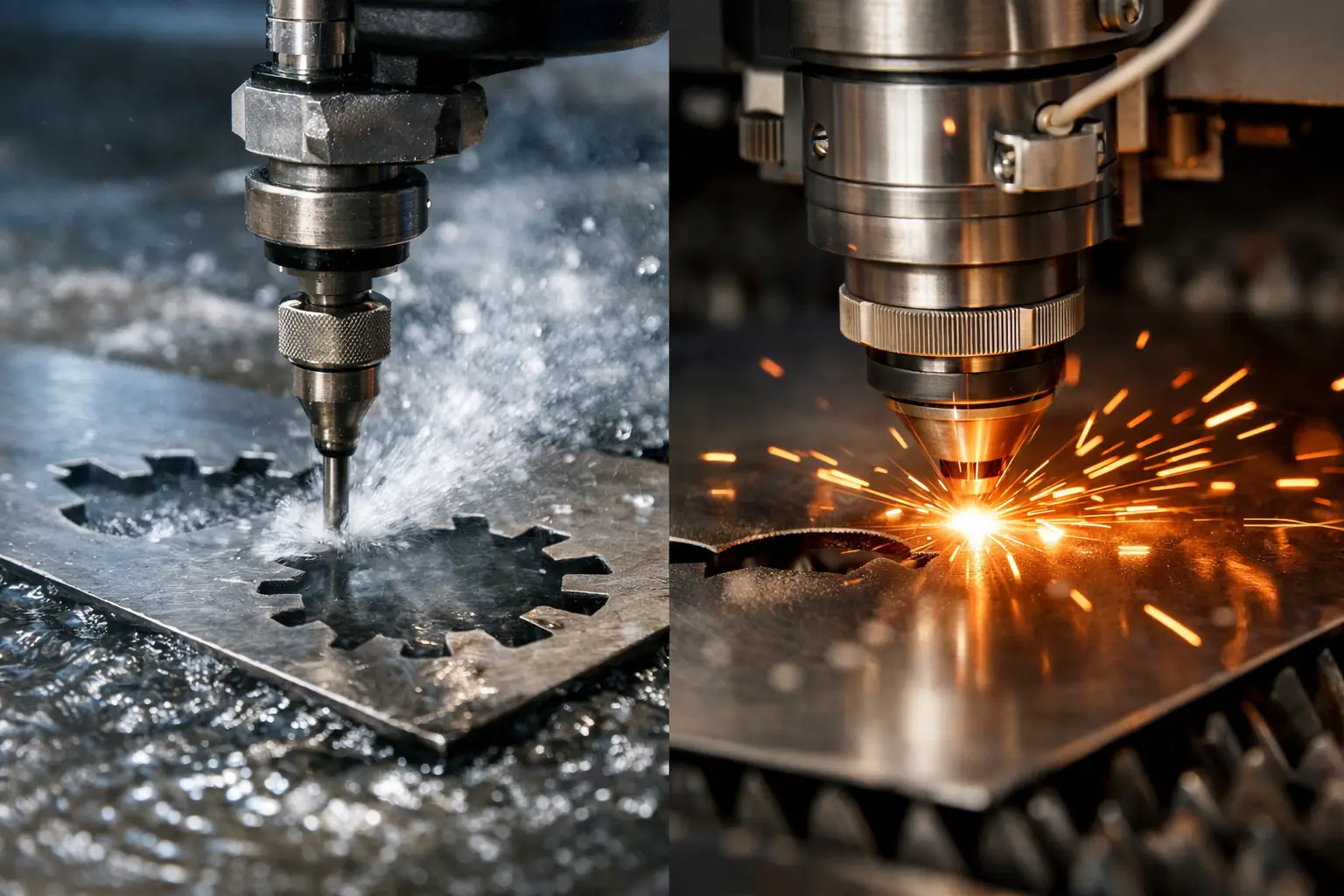
Laser cutting uses a concentrated beam of light to melt or vaporise material. It is exceptionally fast and precise on many sheet-metal jobs. Waterjet cutting uses a high-pressure stream of water, often mixed with abrasive garnet, to erode the material along the programmed path. At pressures up to 60,000 PSI, it cuts without creating a heat-affected zone.
That cold-cut characteristic is the key difference. Waterjet does not heat the cut edge enough to alter the surrounding material structure, create heat distortion or leave a recast layer. Where those effects matter, waterjet can produce a more accurate finished component even if both machines can follow the same CAD profile.
When waterjet is more accurate for your job
The material must stay flat
Thin sheet, narrow webs and intricate cut-outs can move as heat builds during laser cutting. This is especially relevant where a design has long internal cuts, closely spaced features or small tabs that cannot dissipate heat easily. The part may be cut to the correct programmed line but no longer sit flat enough for assembly, welding or installation.
Waterjet avoids thermal distortion. It is often the safer choice for stainless steel, aluminium and other materials where flatness is critical, particularly on detailed profiles. This is not to say laser always warps material. Correct laser settings, nesting and cutting sequence manage heat very effectively. But waterjet removes heat as a variable from the process.
The edge cannot be heat affected
Some jobs need the properties of the material near the edge to remain unchanged. Heat can harden or alter certain steels, affect coatings, and cause a discoloured edge on stainless steel. It can also create issues where a cut part will be machined, formed, bonded or used in a corrosion-sensitive environment.
Because waterjet is a cold process, the edge remains free from thermal stress and heat tint. For precision components that will undergo further fabrication, this can reduce rework and protect the intended performance of the material.
The material is not suited to laser cutting
Waterjet is highly accurate across materials that laser does not always handle as cleanly or safely. Rubber, foam, gasket materials, many plastics, timber, tiles, stone and composite materials are common examples. These materials may melt, burn, char, release fumes or develop an unsuitable edge under a laser beam.
A waterjet stream can produce clean, controlled profiles in these materials without burning the edge. For tile and stone, it can also create detailed shapes, penetrations and curves that would be difficult to achieve with conventional saws. Accuracy here includes preserving the visible face and preventing breakage around fine features.
The plate is thick or the profile is demanding
As metal becomes thicker, every cutting process has to manage the relationship between the top and bottom of the cut. Laser remains an excellent option for many thicknesses, especially when speed is the priority. However, abrasive waterjet is often preferred for thicker materials and complex shapes because it can cut through the full thickness without thermal input.
Waterjet cutting does have kerf taper – the cut can be slightly wider at the top than the bottom if it is run at a fast, standard quality setting. Modern CNC waterjet systems compensate for this by controlling the cutting head angle and slowing strategically around corners and detailed features. The required edge quality and tolerance should be specified before production, as a slower precision cut generally gives a cleaner, squarer result.
Small internal details must remain true
Fine slots, sharp internal corners and decorative patterns test both the machine and the material. On heat-sensitive sheets, laser energy can influence tiny features, especially where cuts are packed close together. Waterjet avoids that heat build-up and can be a stronger choice for intricate profiles in thicker plate or non-metal materials.
There is still a practical limit: waterjet uses a physical stream with a kerf width, so it cannot produce a perfectly sharp inside corner. Like most profile-cutting methods, internal corners have a small radius. Good CAD preparation accounts for this, and an experienced operator can advise where a relief radius or design adjustment will protect the required fit.
When laser cutting may be the more accurate choice
Waterjet is not automatically the best option for every precision job. Laser cutting is often the stronger choice for high-volume sheet-metal parts where speed, consistency and a fine kerf are needed. On suitable thin to medium-gauge steel, stainless steel or aluminium, a high-definition laser can produce excellent edge quality and very accurate small features at a lower cost per part.
Laser may also be preferable when turnaround depends on cutting a large number of simple profiles quickly. If the material is stable under heat, the edge condition is acceptable and the thickness suits the machine, laser cutting can provide the most efficient route to an accurate part.
The useful question is not whether waterjet is more accurate than laser in isolation. Ask whether heat could compromise the final part. If the answer is no, laser may be faster and more economical. If the answer is yes, waterjet can prevent a problem that becomes apparent only during fitting, finishing or installation.
The factors that decide final accuracy
Machine capability matters, but the finished result also depends on preparation and process control. A high-quality cut starts with an accurate drawing. Hole sizes, tolerances, critical dimensions, material grade and required finish should be clear before the job is programmed.
Material condition matters too. Plate that is bowed, scratched or carrying protective film requires the right handling and support. Parts must be held securely so they do not shift during cutting, and cutting paths need to account for lead-ins, pierce locations and the removal of small components from the sheet.
For waterjet work, quality settings are especially important. Faster cuts improve throughput but can leave more taper or stream lag on tight corners. Slower, higher-quality settings improve edge squareness and detail, although they increase cutting time. The right balance depends on whether the part is a hidden structural component, a visible architectural feature or a close-tolerance item that must assemble first time.
Specify the outcome, not just the process
The most useful quote request explains what the part needs to achieve. Include the material and thickness, quantity, drawing format, critical dimensions and whether the edge will be visible, welded, painted, machined or used as-cut. If a part must remain flat, preserve a coating, avoid heat marks or fit with another component, say so early.
At Waterjet & Laser SA, having CNC waterjet and laser cutting available onsite means the process can be selected around the job rather than forced to suit a single machine. That is particularly valuable when a project includes mixed materials, thick plate, fine decorative work and production sheet-metal components.
The best cut is the one that arrives ready for the next operation. Where heat would compromise that result, waterjet accuracy is not simply about a tighter line on a drawing – it is about supplying a part that keeps its shape, properties and purpose from the cutting table to final installation.