
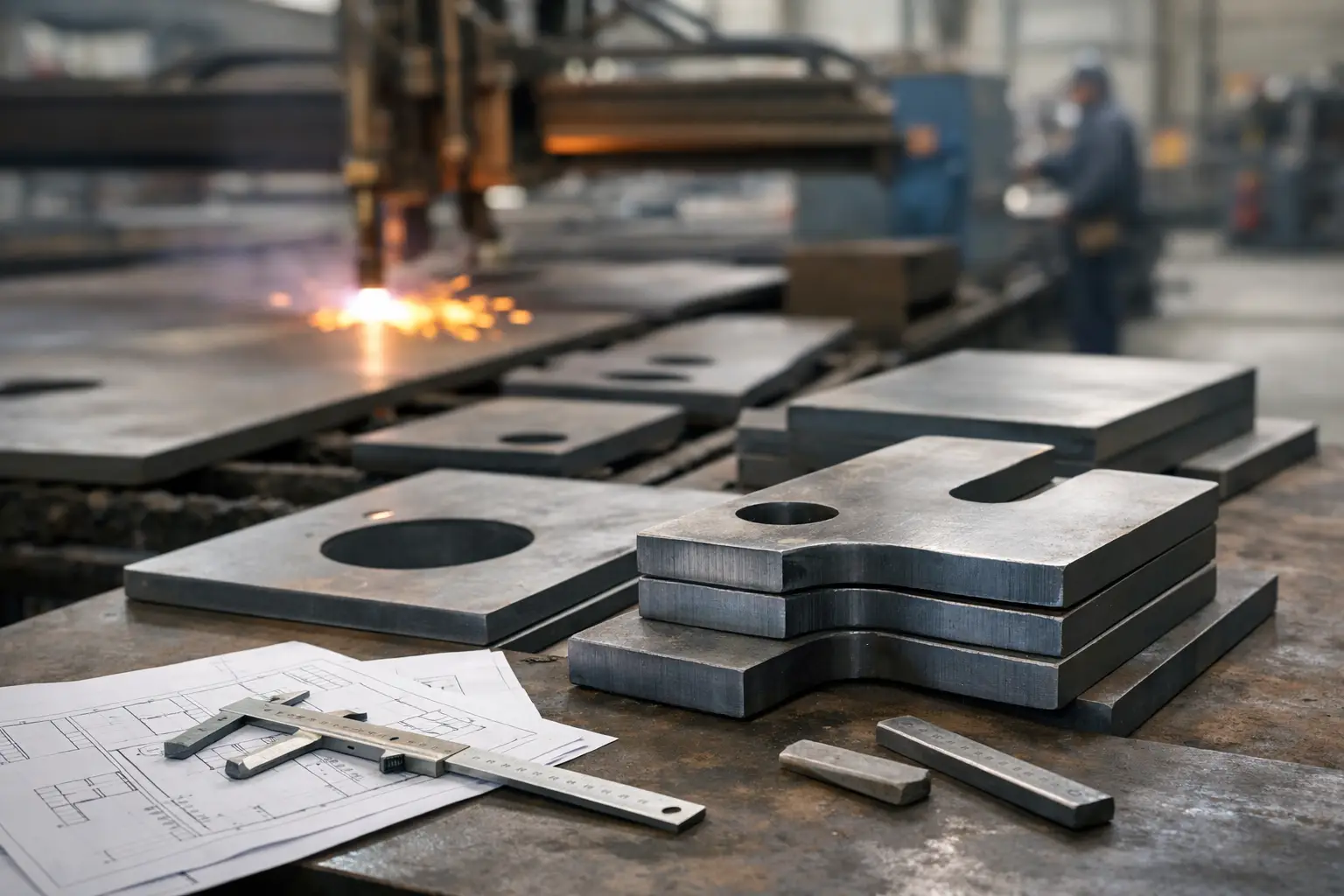
A bracket that is 2 mm out, a hole that needs reworking, or a plate edge distorted by excess heat can hold up an entire fabrication job. Steel plate profiling is the process that turns raw sheet or plate into accurate, repeatable parts ready for folding, welding, machining or installation. When it is specified properly, it reduces workshop handling, protects material quality and keeps the job moving.
For fabricators, builders, engineers and project managers, the requirement is rarely just to cut steel to shape. The part must suit its purpose, arrive when promised and fit with the rest of the assembly. That calls for the right cutting process, clear production information and a supplier that understands the practical consequences of a poor cut.
What steel plate profiling actually involves
Steel plate profiling uses CNC-controlled equipment to cut a programmed shape from steel plate. That shape may be a simple base plate with bolt holes, a run of gussets, flanges and cleats, or a detailed component with internal cut-outs, slots and tight radii. A digital drawing guides the cutting head, giving far greater repeatability than manual marking and cutting.
The value lies in more than dimensional accuracy. Quality profiling considers kerf width, hole size, edge condition, heat input, nesting and the order in which features are cut. These details affect whether a part stays flat, whether holes remain usable without drilling, and how much finishing is needed before fabrication begins.
For one-off work, profiling makes custom components practical without the time spent manually laying out each plate. For production runs, it gives consistency from the first part to the last. It can also improve material yield by nesting parts efficiently across a sheet, reducing offcuts and unnecessary steel costs.
Choosing the right process for steel plate profiling
Laser cutting and waterjet cutting can both produce high-quality steel parts, but they do not deliver the same result in every application. The right choice depends on plate thickness, design detail, required edge condition, tolerance, quantity and the work that follows.
Laser cutting for speed and clean production parts
High definition CNC laser cutting is often the efficient choice for thinner steel plate and repeat production work. It is fast, accurate and well suited to parts with holes, slots, tabs and detailed profiles. For many fabrication components, laser-cut parts arrive with a clean edge that can move directly to the next operation.
Because laser cutting uses heat, it produces a heat-affected zone at the cut edge. In suitable material thicknesses and correctly managed cutting conditions, this is generally small and acceptable for a wide range of fabrication work. However, it can matter where a component is particularly sensitive to heat, where distortion must be minimised, or where edge metallurgy is critical to the application.
Laser cutting is commonly a strong option where turnaround, repeatability and competitive pricing are priorities. It is particularly effective when several parts can be nested efficiently and cut in a single production run.
Waterjet cutting where heat cannot be tolerated
Waterjet cutting uses a high-pressure stream of water, typically up to 60,000 PSI, combined with abrasive material to cut through steel plate. It is a cold-cut process, meaning it does not create a heat-affected zone or heat distortion in the workpiece.
That makes waterjet a practical choice for thicker material, heat-sensitive work and parts requiring close attention to material integrity. It can cut complex shapes, narrow slots and internal profiles without changing the properties of the surrounding steel. The process is also valuable when a job includes several material types, such as steel alongside stainless steel, aluminium, rubber or gasket material.
The trade-off is speed. Waterjet cutting can take longer than laser cutting, especially on production quantities where laser is well matched to the plate thickness. Yet where avoiding heat damage eliminates straightening, machining or rejected parts, waterjet can be the more economical choice overall.
Drawings and details that prevent delays
Accurate cutting begins before the plate reaches the machine. A clear file and a few job-specific details allow the cutter to select the correct process, quote accurately and plan the work without avoidable back-and-forth.
For most steel plate profiling jobs, provide:
- a dimensioned PDF, DXF, DWG or other suitable CAD file;
- the steel grade and plate thickness;
- required quantity and whether the work is a one-off or repeat order;
- critical dimensions, tolerances and hole requirements; and
- any downstream processes, such as folding, welding, machining, galvanising or powder coating.
Not every dimension needs an exceptionally tight tolerance. Applying tight tolerances across a whole part can add cost without improving the final assembly. It is usually better to identify the dimensions that locate the component or affect fit-up, then allow standard cutting tolerances elsewhere.
Hole size deserves similar attention. Very small holes relative to plate thickness can be challenging with any cutting method, and their finish may not suit every fastening or tapping requirement. If holes will be threaded, reamed or machined after profiling, say so early. A small allowance or pilot-hole approach may be the better production decision.
The same applies to cut edges. A welded bracket may only need a clean profile ready for fit-up, while an exposed architectural component may require a more refined edge and careful handling to protect its visible face. The intended use should guide the process, rather than assuming every part needs the same finish.
Profiling decisions that affect fabrication quality
A profile can be perfectly cut and still create issues if it has not been designed for fabrication. Sharp internal corners, for example, are difficult for many cutting processes to achieve exactly as drawn because cutting tools have a kerf or stream width. Adding an appropriate internal radius can improve accuracy and reduce stress concentration in the finished part.
Tabs and slots can make assembly quicker, particularly for frames, enclosures and repeated fabricated items. They help locate components before welding and reduce measuring time on the workshop floor. Their dimensions must account for material thickness, cutting tolerance and any coating or finish applied later.
For plate that will be folded, bend allowances and relief details need to be included in the drawing. Profiling can prepare the part precisely, but it cannot compensate for bend data that has not considered the material, tooling and final angle. Early coordination between the designer, cutter and fabricator saves rework when the part reaches the press brake.
Nesting also matters. Parts can often be arranged to reduce waste, but the most efficient layout is not always the best commercial outcome. A job requiring urgent delivery may favour speed over maximum sheet utilisation, while a larger production run may justify more detailed nesting to lower the material cost per part. Good service means discussing that balance rather than treating every order the same way.
Why local cutting capacity matters
When a project is waiting on steel parts, delays are not confined to the cutting stage. They affect welding schedules, site installation, freight and labour allocation. Access to both laser and waterjet cutting in one Adelaide facility gives customers a practical advantage: the process can be selected around the job rather than forcing every part through the same machine.
For South Australian fabricators and project teams, local communication also makes it easier to resolve drawing questions, adjust quantities or arrange collection and delivery. Waterjet & Laser SA supports work ranging from straightforward production components to intricate custom profiles, with the same focus on accurate parts and dependable turnaround.
The best next step is to review the plate profile in the context of the finished job. Share the drawing, material details and required date, then ask which process will give the right edge quality and accuracy without paying for specifications the part does not need. That conversation is often where a cutting order becomes a smoother fabrication job.