
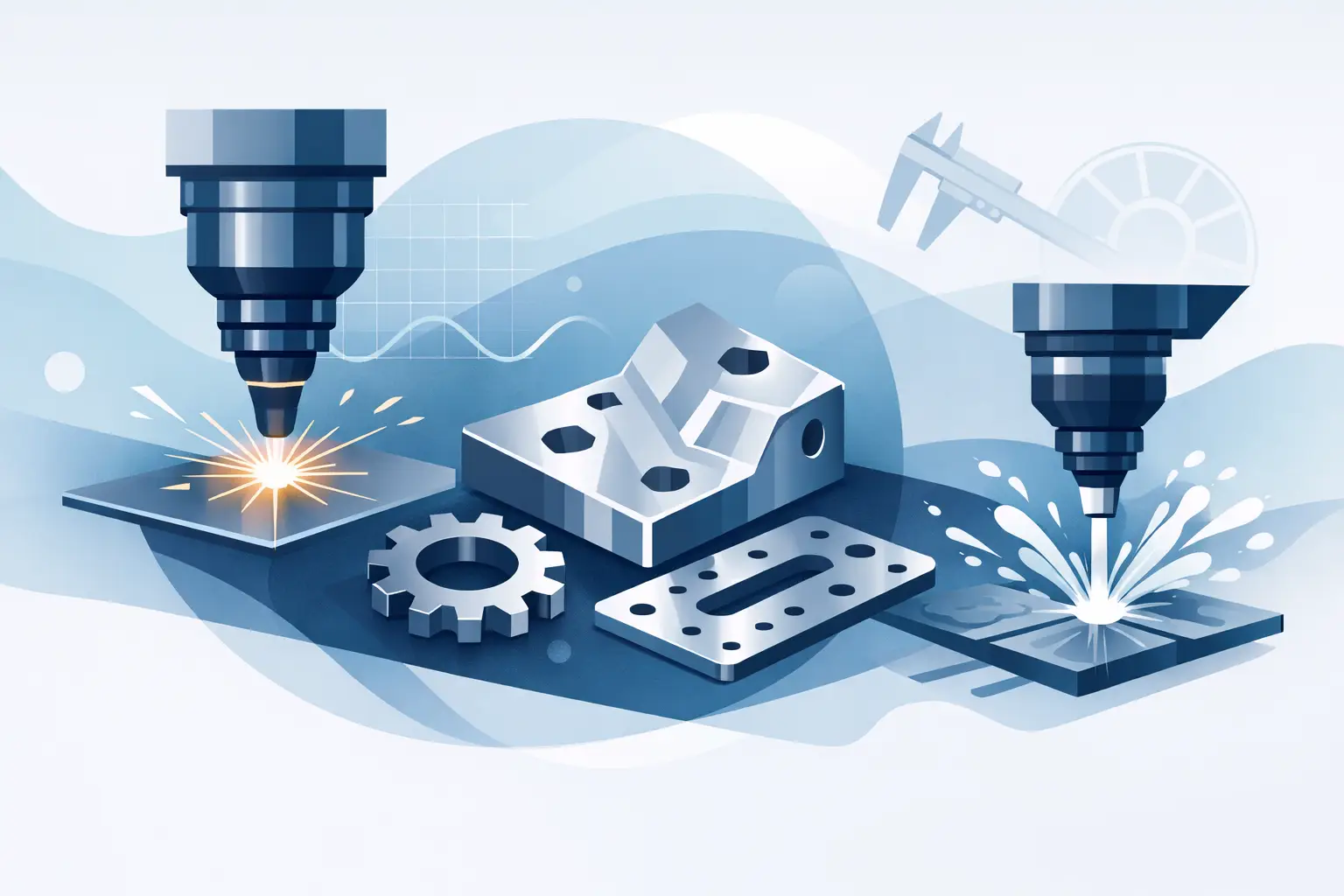
A part that arrives late, distorted or a few millimetres out can hold up an entire fabrication job. That is why precision cutting services are not simply about putting material through a machine. They are about supplying parts that fit the first time, protect the next stage of production and keep a project moving.
For Adelaide fabricators, builders, manufacturers, designers and project managers, the right cutting process depends on the material, thickness, finish required and deadline. CNC laser and waterjet cutting each have clear strengths. Choosing between them early can reduce rework, material waste and unnecessary fabrication time.
What precision cutting services should deliver
Precision begins well before cutting starts. A reliable provider reviews the drawing, confirms material requirements and selects a process that suits the job rather than forcing every component through the same machine. The result should be consistent dimensions, clean profiles and parts that are ready for fabrication, assembly or installation.
For production work, consistency matters just as much as the first piece. Brackets, panels, gussets, machine components and repeated architectural elements need to match from one part to the next. For custom work, accuracy makes intricate patterns, fine detail and tight-fitting features practical without hours of hand finishing.
Good service also means clear communication around lead times, material suitability and any design details that could affect the finished part. A simple conversation before cutting can identify sharp internal corners, narrow sections, heat-sensitive materials or tolerances that need extra care.
Laser cutting or waterjet cutting?
Laser cutting is often the efficient choice for many metal parts, particularly where speed is a priority. A CNC laser produces accurate profiles in steel, stainless steel and aluminium, making it well suited to production components, fabrication parts, signage, screens and detailed sheet-metal work. The focused beam creates a narrow cut, allowing close nesting of parts and helping reduce material offcuts.
There is, however, heat involved. In many jobs this is entirely acceptable, and laser cutting provides a clean, efficient result. Yet thin sections, certain alloys or components that must avoid a heat-affected zone may require a different approach. The best process is determined by the outcome required, not by a one-size-fits-all rule.
Waterjet cutting uses a high-pressure stream of water, with abrasive added when cutting hard materials. At pressures up to 60,000 PSI, it can cut steel, stainless steel, aluminium and a broad range of other materials without introducing heat into the cut edge. This cold-cut process avoids heat distortion and helps preserve the material’s original properties.
That makes waterjet a strong option for thicker material, heat-sensitive work, complex profiles and materials that do not suit laser cutting. It can also cut foam and other non-metal materials, giving project teams more flexibility when a job includes mixed materials or unusual design requirements. Waterjet may be slower than laser on certain thin metal applications, but the absence of thermal stress can make it the better value choice when edge integrity is critical.
The edge finish is part of the specification
A cut edge affects more than appearance. It can influence welding preparation, coating results, fit-up and the amount of finishing required before a part can be used. Heat tint, burrs, taper and roughness are not always defects, but they need to be appropriate for the application.
For example, a workshop producing structural brackets may prioritise repeatability and fast turnaround. An architectural fabricator cutting visible stainless-steel details may place greater value on an edge that needs minimal finishing. A machine part might need particular care around holes, slots and mating faces. Providing the intended use of the part helps the cutting team make the right recommendation.
Better drawings lead to better cut parts
The most efficient jobs start with clear, production-ready files. DXF files are commonly preferred for CNC cutting because they provide accurate vector geometry. Clean files reduce time spent interpreting dimensions and lower the risk of unwanted duplicate lines, open contours or incorrect scaling.
If a drawing is not yet ready for cutting, it is worth checking the basics before sending it through. Confirm units, overall dimensions, material thickness, quantities and which features are critical. Clearly identify holes, cut-outs, fold allowances where relevant, and any areas that must remain free from tabs or witness marks.
Design choices can also influence cost and quality. Very small holes in thick plate, extremely narrow webs and tight internal corners can increase cutting time or require process adjustments. Where the design allows it, adding sensible radii to internal corners and avoiding unnecessarily fine detail can improve strength and reduce cutting costs without changing the function of the part.
For decorative work, scale is particularly important. A screen pattern that looks balanced on a computer may have fragile bridges or awkwardly small openings once transferred to a full-size panel. Reviewing the design in relation to material thickness, panel size and mounting method helps ensure the finished piece is both visually effective and durable.
Where accuracy protects your schedule
Outsourcing cutting is often more practical than buying, maintaining and operating specialised machinery in-house. The value is not only in machine access. It is in having the right process available when workload increases, a deadline tightens or a design calls for capability outside a workshop’s usual equipment.
Precision-cut components can arrive ready for the next operation, reducing manual marking-out, drilling, grinding and correction work. This allows skilled tradespeople to spend more time welding, forming, assembling or installing rather than rectifying poorly cut material.
It also supports better project planning. When parts are supplied accurately and on time, material ordering becomes more predictable and downstream trades are less likely to be waiting on a missing component. This is especially relevant for regional South Australian projects, where a second delivery or replacement part can add significant delay.
Waterjet & Laser SA combines onsite CNC laser and waterjet capability so customers can select the process that best suits the job. That choice matters when a project needs fast laser-cut metal parts alongside cold-cut components, intricate decorative work or materials outside the usual sheet-metal range. Local service and dependable delivery across metropolitan Adelaide and country areas help keep that capability close to the job site.
Questions worth asking before you place an order
Before committing material and time, ask what process is recommended and why. A capable cutting provider should be able to explain whether laser or waterjet is better suited to the material, thickness and finish you need. Ask about expected turnaround, whether supplied material is suitable, and whether the finished parts will need deburring or other secondary work.
It is also useful to discuss quantity. A one-off prototype, a short fabrication run and a repeating production order may need different nesting, programming and scheduling approaches. Planning repeat work properly can improve consistency and make future orders quicker to process.
Finally, be specific about what cannot go wrong. If a hole position is critical, a panel has a visible face, or a part must fit another component without adjustment, say so at the outset. The more clearly the functional requirement is understood, the more effectively the cutting process can be matched to it.
The best cut part is rarely the one with the lowest initial price alone. It is the one that arrives accurate, suits its purpose and lets the people after you get straight on with their work.