
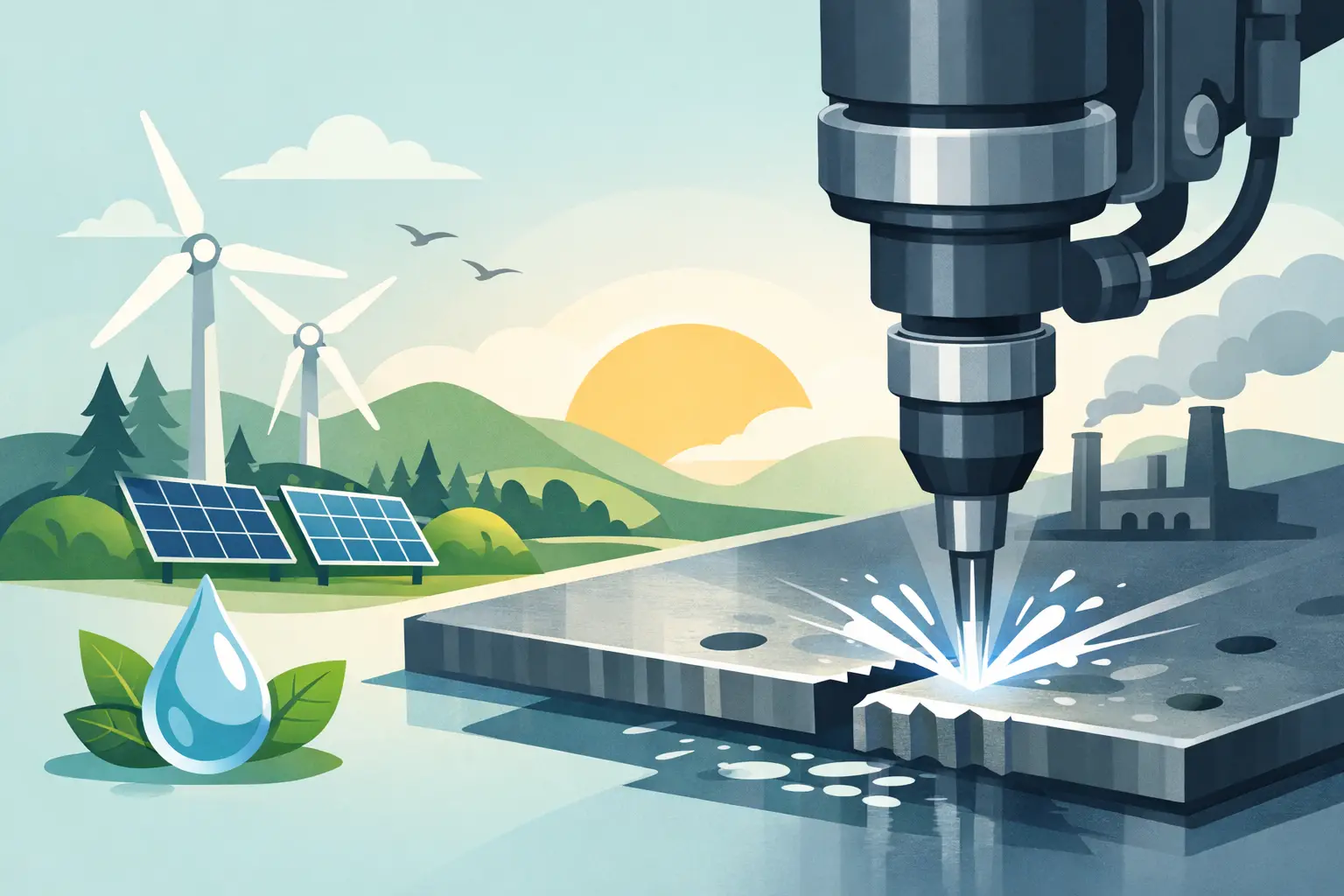
A thick stainless bracket with a heat-affected edge can create more waste than the offcut it was cut from. It may need extra finishing, lose corrosion resistance around the cut, or fail to meet a tight tolerance altogether. That is where eco-friendly waterjet cutting earns its place: it is not simply about using water, but about reducing avoidable rework, preserving usable material and selecting a cutting method that suits the job.
For Adelaide fabricators, builders, manufacturers and designers, sustainability is increasingly practical. Material costs matter. Disposal costs matter. So do delayed jobs, rejected parts and the energy used to remake them. Waterjet cutting can support a more resource-conscious workflow, provided its strengths and limitations are understood.
What makes waterjet cutting more environmentally considerate?
A CNC waterjet directs a very high-pressure stream of water, often combined with abrasive garnet for hard materials, through a programmed cutting path. At pressures up to 60,000 PSI, it can cut steel, stainless steel, aluminium, stone, composites, rubber and many other materials with impressive accuracy.
The key environmental advantage is the cold-cut process. Unlike thermal cutting methods, waterjet cutting does not create a heat-affected zone in the material. There is no heat distortion around the edge, no burnt coating and no need to allow for a material changing shape as it cools.
That directly affects waste. When a part comes off the bed close to its required dimension, with a clean edge and stable material properties, there is less grinding, less secondary machining and fewer rejected components. For a one-off architectural feature, that may prevent expensive material from becoming scrap. For repeat production work, the savings can accumulate across every batch.
Waterjet cutting also avoids the fumes associated with melting or burning material. This can make it a sensible option for materials that respond poorly to heat, including certain laminated, coated or composite products. It does not remove the need for proper workplace controls, particularly around abrasive handling and slurry, but it does avoid a thermal cutting source at the point of cut.
Eco friendly waterjet cutting is about the whole process
Calling any industrial process environmentally friendly without qualification is too simple. Waterjet systems use electricity to pressurise water, and abrasive cutting uses garnet. The spent water and abrasive form slurry that must be managed correctly, especially when cutting materials that may introduce metal particles or other contaminants.
The better question is whether waterjet is the most efficient process for the material, thickness and required finish. A well-run job considers more than the cutting stage. It considers material yield, setup time, nesting, edge quality, transport, finishing and the likelihood of needing to make the part again.
For example, a high-accuracy aluminium component might be cut without introducing heat distortion that would otherwise require straightening. A complex stainless steel profile can be nested closely with other parts to reduce offcuts. Foam, rubber and softer materials can be cut precisely without the compressed edges or melting that some thermal processes may cause.
These outcomes are not automatic. They depend on accurate drawings, suitable tolerances, sensible part orientation and a cutting partner that understands the difference between a nominally cut part and a production-ready one.
Less heat can mean less downstream work
Heat is often the hidden source of material loss in fabrication. A warped sheet can be difficult to recover. A hardened edge can slow later machining. A discoloured or oxidised area may need cleaning before a visible architectural finish is acceptable.
Because waterjet is cold cutting, the cut edge retains the material’s original characteristics more reliably. This is particularly valuable where flatness, strength, finish or corrosion performance matters. It can also reduce the chemicals, consumables and labour associated with cleaning up a heat-affected edge.
That does not mean waterjet is always the fastest route. Laser cutting can be an excellent choice for thinner metals, particularly when speed and repeatability are the priority. The most responsible choice is often the one that produces the required part efficiently the first time, rather than applying one process to every job.
Better nesting protects valuable sheet material
Material is often the largest cost in a cut-part job, and it carries an environmental cost before it reaches the cutting bed. Efficient CNC nesting places parts carefully within a sheet to maximise yield while maintaining enough separation for clean cutting.
Close nesting is especially useful for costly stainless steel, aluminium and decorative metals. Even small improvements in yield can reduce the number of sheets required over a project. The remaining offcuts may also be large enough to retain for smaller future components rather than being sent straight to recycling.
Good nesting needs practical judgement. Packing parts too tightly can compromise cut quality or make handling awkward, while excessive tabs or complicated break-out work can add labour. The aim is not theoretical zero waste. It is a dependable balance between material efficiency, safe handling and finished-part quality.
Where waterjet makes the strongest practical difference
Waterjet cutting is particularly useful when the job has a combination of thickness, intricate detail and sensitivity to heat. It gives fabricators and project managers flexibility where conventional thermal cutting may introduce unwanted compromises.
For structural and industrial work, this may include thick steel plates, brackets, flanges, wear components and machine parts. For architectural and design work, it can mean intricate screens, signage elements, decorative metalwork and custom profiles that need crisp detail without visible heat marks.
The process is also valuable for mixed-material work. A project may involve stainless steel alongside aluminium, rubber, foam or composite materials. Rather than forcing every component through a heat-based process, waterjet can cut many of these materials on the same type of machine while protecting their condition.
Waterjet & Laser SA uses on-site CNC waterjet and laser capability so the process can be selected around the actual requirement. That matters because the lowest-impact option is not always one machine or one marketing claim. It is the process that delivers the correct edge, tolerance and turnaround without unnecessary material loss or secondary work.
The trade-offs worth discussing before cutting
Waterjet is precise and versatile, but it is not a free-cutting process. Abrasive waterjet jobs consume garnet, require high-pressure pumping and generally take longer than laser cutting on some thin metal profiles. If the specification does not require cold cutting or the material is thin and straightforward, laser may offer a faster and more economical result.
Cut quality also depends on thickness, material and speed. A faster cut can leave more taper or striations than a slower, higher-quality cut. For components that will be welded, painted or hidden within an assembly, a standard cut edge may be entirely appropriate. For an exposed architectural part or a precision mating surface, a finer finish may justify additional cutting time.
It is worth clarifying the intended use of each part before production begins. Useful details include the material grade and thickness, required tolerances, whether edges will be visible, any later folding or welding, quantity, and whether the supplied file is ready for cutting. Those details help avoid over-specifying the job or discovering too late that a different process would have been better.
How customers can reduce waste before the job starts
The most effective sustainability decisions are often made before a sheet is loaded. Start with a clean, accurately scaled DXF or other suitable production drawing. Check that duplicated lines, open vectors and unnecessary detail have been removed, as these can increase cutting time and create avoidable errors.
Consider standard sheet sizes during design where possible. A minor adjustment to a part layout can improve nesting and reduce offcuts without changing the final function. If multiple components use the same material, grouping them into one run may also make better use of the available sheet.
Be clear about tolerances rather than applying the tightest possible tolerance everywhere. Precision is valuable where parts interface, align or perform a critical function. It is less useful on a non-critical cover plate, and unnecessary precision can add time and cost. The same principle applies to edge finish: specify the level the project needs, not more.
Finally, plan what happens to offcuts and finished parts. Reusable remnants can be retained for future work. Metal scrap should enter an appropriate recycling stream. Finished components should be packed and transported in a way that protects the cut edge, because damage during handling can undo the savings achieved during production.
Precision is a practical form of sustainability
The environmental case for waterjet cutting is strongest when it is measured in outcomes: fewer remakes, less heat-related damage, efficient use of valuable material and a process selected for the application rather than habit. Water alone does not make a cutting method sustainable. Careful planning and accurate execution do.
If a project involves thick material, intricate profiles, mixed materials or an edge that cannot be compromised by heat, ask for the cutting method to be assessed before production starts. A better decision at that point can save material, time and unnecessary work long after the parts leave the cutting bed.